How Does Peptac Work? The Science Behind the Relief
Heartburn has a way of demanding immediate attention. The burning sensation rising from the chest, the sour taste at the back of the throat, the inability to lie flat; when it hits, relief becomes urgent rather than optional.
For many people in the UK, Peptac has become the dependable answer: a liquid antacid that’s widely prescribed, often recommended in pregnancy, and quietly relied on night after night. But while most people know that it works, fewer understand how it works or why it feels different from standard chewable antacids.
This article explains the mechanism behind Peptac in clear, practical terms. It combines the underlying science with real user experiences to show what’s happening after you take a dose - and why timing, positioning, and expectations matter when it comes to getting the best results.
The short answer: Peptac works in two complementary ways
Peptac is classified as an alginate antacid, which means it does more than simply neutralise stomach acid.
It works through two distinct but coordinated actions:
First, it neutralises the acid already present in the stomach. This comes from its antacid components, which reduce the acidity responsible for the immediate burning sensation.
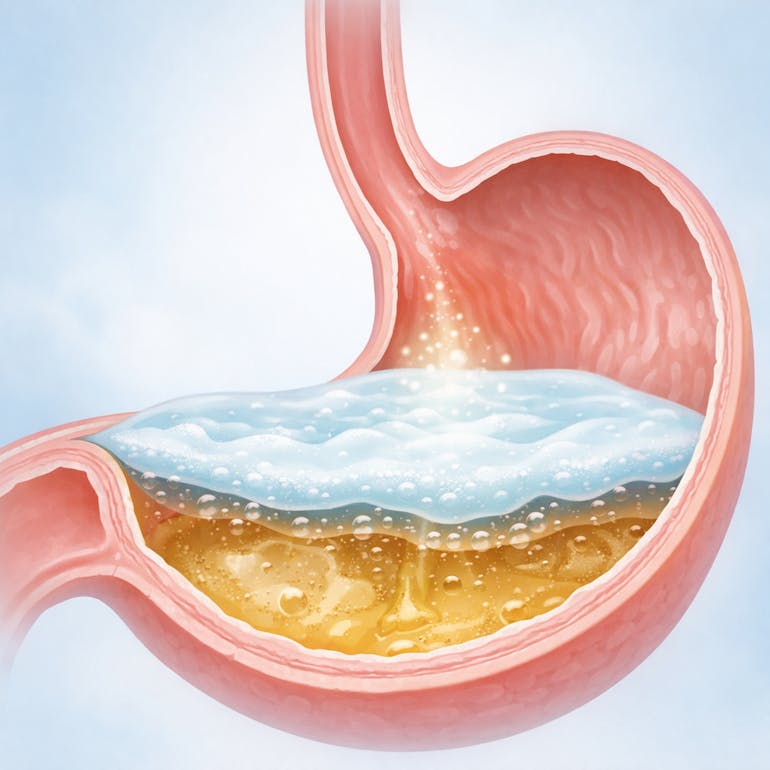
Second, it forms a physical barrier that helps prevent reflux from occurring. This barrier, often referred to as a "raft", sits on top of stomach contents and helps stop acid from travelling back up into the oesophagus.
Together, these actions explain why many users describe Peptac as working both quickly and for several hours, rather than offering brief, stop-start relief.
What happens after you swallow Peptac
Once a dose of Peptac reaches the stomach, its three active ingredients begin working almost immediately.
- Sodium alginate, derived from seaweed, reacts with stomach acid to form a gel.
- Sodium bicarbonate helps neutralise acid and produces carbon dioxide gas.
- Calcium carbonate provides additional neutralisation and strengthens the gel structure.
Within seconds, the alginate transforms from a liquid into a light, foamy gel. The carbon dioxide becomes trapped inside it, allowing the gel to float. This floating layer settles on top of stomach contents, forming what clinicians refer to as an alginate raft.
Because the raft forms so quickly, many people notice relief almost straight away.
"Worked within minutes. I find Peptac coats my throat really well and takes the sting out of reflux straight away." -u/Captaincrunch396
Why the raft matters
Heartburn occurs when acidic stomach contents reach the lining of the oesophagus, which has very little natural protection against acid. The alginate raft helps in several important ways:
- It has a near-neutral pH, so if it reaches the oesophagus, it doesn’t burn
- It acts as a physical barrier, blocking acid from moving upwards
- It remains buoyant, even when you lie down or change position
- It typically lasts three to four hours, covering the periods when reflux is most likely
Research suggests that during a reflux episode, the raft can actually move ahead of the acid itself - meaning the oesophagus is exposed to a neutral gel rather than corrosive stomach contents.
For many people, that physical protection is what makes Peptac feel different from standard antacids.
"I was prescribed Peptac during pregnancy and it’s the only thing that let me sleep through without that awful burning." -u/hydrolentil
Acid neutralisation: the immediate relief layer
While the raft is forming, Peptac’s antacid components are already reducing acidity within the stomach. This dual timing explains the typical experience users describe:
- Fast relief as acidity drops
- Sustained protection as the raft prevents new reflux
This is also why Peptac feels very different from proton pump inhibitors (PPIs). PPIs reduce acid production over hours or days, while Peptac works mechanically and immediately, making it particularly useful for meal-related or positional reflux.
Why formulation makes a difference
Not all alginate products behave the same way. The effectiveness of the raft depends on how strong and stable it is once formed.
Peptac’s inclusion of calcium carbonate helps create a more cohesive gel, making the raft better able to withstand stomach movement. While some premium brands may form denser rafts, studies show that Peptac still provides reliable physical protection for the full duration of action.
In practical terms, this means consistent relief without needing an overly heavy or difficult-to-tolerate formulation.
What relief actually feels like
Many users describe a noticeable coating sensation shortly after taking Peptac. This isn’t imagined - it reflects the gel interacting with irritated tissue.
"The thickness helps to block the acid more from coming back up my oesophagus."
- Reddit user, r/PregnancyUK
Others focus on how quickly symptoms settle.
"Doctor told me to get Peptac - same as Gaviscon Advance but cheaper. Worked within minutes." -u/WaitingTillJuly17
And for people affected at night, duration matters just as much as speed.
"It’s the only thing that let me sleep without waking up on fire." -u/hydrolentil
That three-to-four-hour window is often enough to cover the post-meal period or the early part of the night when reflux tends to be worst.
When Peptac doesn’t fully solve the problem
Peptac isn’t designed to suppress acid production. If reflux is severe, continuous, or driven by underlying conditions such as significant GERD or a hiatal hernia, the raft may be overwhelmed.
"Peptac kinda works, but not 100%. I still wake up with reflux some nights." -u/PartialRelief
In these cases, Peptac often plays a supporting role rather than being the sole solution - alongside lifestyle changes or prescription treatment.
Timing matters more than most people realise
Peptac works best when taken after meals and before bed. A full stomach provides something for the raft to float on, allowing it to sit in the right position.
Taking it on an empty stomach reduces its effectiveness.
Staying upright for a short period after dosing also helps the raft settle properly - a tip many experienced users instinctively follow.
"Take it after meals and again before bed - it works better that way." -u/Captaincrunch396
Safety and tolerability
Because Peptac works locally in the gut rather than systemically, very little enters the bloodstream. This is why it’s widely considered safe for long-term use and is commonly recommended during pregnancy and breastfeeding.
Side effects tend to be mild and include bloating, constipation, or dislike of the taste, none of which reflect harmful changes within the body.
"Tastes awful, but honestly, it saved my nights." -u/Cesssmith
Spacing Peptac at least two hours away from other oral medicines helps prevent interference with absorption.
The bottom line
Peptac works because it tackles heartburn on two levels at once: reducing acidity and physically preventing reflux.
The science behind alginate rafts is well established, and real-world experiences closely match what studies predict - fast relief, a protective coating sensation, and several hours of meaningful comfort.
Used correctly - after meals, before bed, and with realistic expectations - Peptac remains one of the most practical, low-risk options for managing mild to moderate reflux.
For many people, that floating barrier makes the difference between lying awake with burning discomfort and finally being able to rest.
