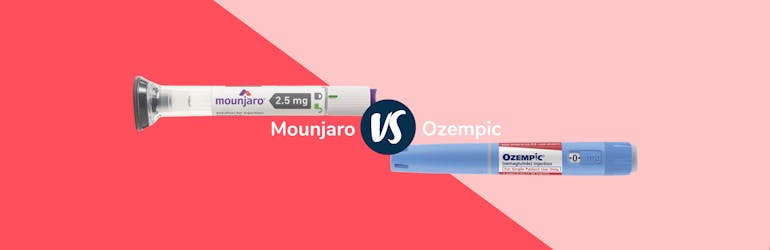
Mounjaro vs Ozempic - How do they compare
When choosing a weight loss injection, many people compare Mounjaro and Ozempic. While both work by mimicking natural gut hormones to reduce appetite and regulate glucose levels, growing clinical evidence suggests meaningful differences in how effective they are, which may influence which treatment is right for you.
How These Medications Work Differently
Both medicines act on the incretin system but through different mechanisms. Ozempic contains semaglutide, which mimics the GLP-1 hormone to promote feelings of fullness, reduce appetite and improve blood sugar control. Mounjaro takes a dual-hormone approach: its active ingredient, tirzepatide, targets both GLP-1 and GIP receptors.
The most notable distinction comes from comparative clinical and real-world studies. Data indicates that people using Mounjaro tend to achieve greater average weight loss than those using Ozempic over a similar treatment period. In a large real-world analysis, patients treated with Mounjaro experienced around 15% weight reduction at one year, compared with approximately 8% in those using Ozempic, highlighting a clear difference in outcomes for many patients.
Here are the key differences at a glance:
- Active ingredient: Mounjaro contains tirzepatide, while Ozempic contains semaglutide.
- Dosing schedule: Mounjaro starts at 2.5mg and increases up to 15mg; Ozempic starts at 0.25mg and increases up to 2mg.
- Weight loss potential: Mounjaro is associated with greater average weight loss, with clinical studies showing up to 15.2% reduction compared to 7.9% with Ozempic.
- Side effects: Both can cause gastrointestinal issues, but the rates are similar between the two medications.
- NHS availability: Mounjaro is approved for weight loss in the UK; Ozempic is primarily approved for type 2 diabetes.
Weight loss results
Clinical studies, including a large real-world analysis by Truveta Research, have demonstrated that Mounjaro leads to greater weight loss than Ozempic. At one year, patients on Mounjaro experienced an average weight reduction of 15.2%, compared to 7.9% for those on Ozempic. The likelihood of achieving significant weight loss milestones - such as 5%, 10%, or 15% of body weight - is higher with Mounjaro, making it a strong contender for those prioritising weight reduction. Both medications are effective, but Mounjaro’s dual hormone action appears to offer a distinct advantage for weight management.
Real user experiences
Users on Reddit frequently report positive outcomes with both medications, though experiences vary. Many Mounjaro users mention minimal side effects and steady progress, with some noting a reduction in food cravings and hunger. Ozempic users have reported a range of experiences, with some experiencing significant weight loss and others facing challenging gastrointestinal side effects such as nausea, vomiting, and diarrhoea.
"Was on OZ for just over a year, lost 35lbs and felt good. Stayed fairly low dose, moving to 0.75 mg/wk for the last few months but had stalled and the appetite suppression seemed to be fading. Rather than increasing dose on OZ, I decided to try MJ, starting at 5mg. Wow - Big difference for me. I’ve been on it 4 wks now and the appetite suppression is strong, the scale is moving again and (oddly) my bowels are moving regularly again - wasn’t expecting that. No side effects other than mild nausea on the morning after my shot. I’ll be sticking with MJ now for sure." -northernlights01
"I’ve been on Mounjaro, after being on Ozempic for a year, for the last 4 months. I started on 7.5, and boy, it’s way more effective, to me, than Ozempic. [...] The scale finally started to move for me after my switch, and I’m loving it." -Realistic-Lake-6732
"Mounjaro works much much better for me. I had to switch to OZ during the MJ shortage and my blood sugar was consistently 20 points higher than on MJ. I switched back after a few months and my blood sugar went right back to 80-110." -ChaiTeaLatte13
"My wife has been on both, and vastly prefers the Mounjaro, because a) the side effects are fewer, and b) the Mounjaro injection is smaller, and more consistent in how long it takes. (Ozempic injections take longer if the pen is almost exhausted, because the spring in the pen can't exert as much force.) I've taken the oral form of Ozempic (Rybelsus), and it was significantly less effective than either Trulicity or Mounjaro, and the side effects were worse. I've found Mounjaro to be the most effective for myself." -GolfballDM
Availability
Both Mounjaro and Ozempic are available in the UK, either through private prescription or, in some cases, via the NHS for specific medical indications. Mounjaro is approved for weight loss and type 2 diabetes, while Ozempic is approved for type 2 diabetes but is often prescribed off-label for weight loss. NHS access may be restricted and is typically reserved for those who meet strict clinical criteria.
Key comparisons
| Feature | Mounjaro | Ozempic |
|---|---|---|
| Active ingredient | Tirzepatide | Semaglutide |
| Dosing schedule | 2.5mg–15mg weekly | 0.25mg–2mg weekly |
| Weight loss potential | Up to 15.2% | Up to 7.9% |
| Side effects | Gastrointestinal, similar rates | Gastrointestinal, similar rates |
| NHS availability | Approved for weight loss | Approved for diabetes |
Both Mounjaro and Ozempic are clinically proven weight loss injections, but evidence suggests Mounjaro delivers greater average weight reduction for many patients due to its dual GLP-1 and GIP action. This makes it an appealing choice for those seeking more pronounced appetite control and metabolic support, while Ozempic remains a well-established option for managing type 2 diabetes alongside weight loss. Your decision should consider individual weight loss goals, tolerability, prescription access, and cost, whether via private treatment or the NHS.
This article has been fact-checked for accuracy by Alessandro Grenci, Superintendent Pharmacist at medino.
Sources (tap to expand)