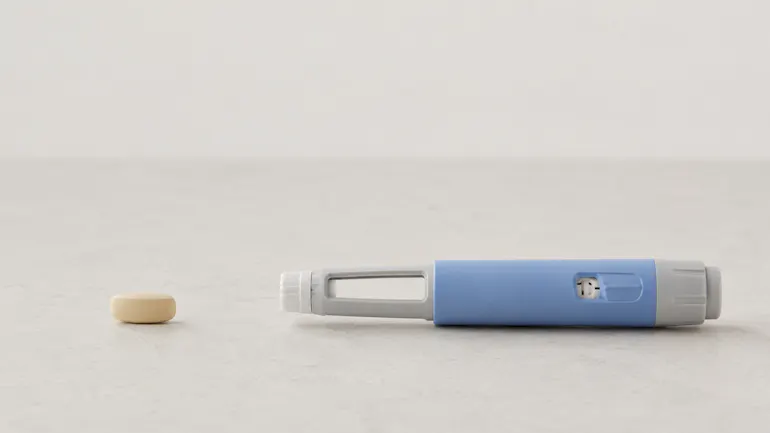
Orforglipron vs Wegovy vs Mounjaro: How These Weight-Loss Medicines Compare
Wegovy and Mounjaro have been prescribable in the UK for a while. Foundayo (orforglipron) is the newest of the three, authorised by the MHRA on 10 August 2026 — which changes what's worth comparing, but not, on its own, which medicine might suit any one person best. All three act on the same core hormone pathway, but they differ in molecule type, how they're taken, what the trial evidence actually shows, and where each currently stands with the NHS. a
Key takeaways
- All three medicines activate the GLP-1 receptor, but Mounjaro also activates a second receptor (GIP), and orforglipron is chemically different from the other two in a way that's why it can be a tablet at all.
- Trial-average weight-loss figures for the three medicines come from three separate trials with different populations, protocols and (for orforglipron and Mounjaro) more than one way of analysing the same result — they aren't a clean, direct ranking.
- No dose-equivalence has been established between orforglipron, semaglutide and tirzepatide — a given number of milligrams of one doesn't correspond to a specific dose of another.
- Going needle-free is a genuine trade-off, not an automatic upgrade: a tablet every day, indefinitely, is a different kind of commitment to a device once a week.
- Of the three, Foundayo is currently the only one without a settled NHS funding position — checked as of 13 August 2026.
Mechanism of action: what's actually different
All three medicines work, at least in part, by mimicking GLP-1, a hormone the gut releases after eating that increases feelings of fullness and helps regulate appetite. That shared target is why they're grouped together, but the way each one reaches it is genuinely different.
Wegovy (semaglutide) is a peptide-based GLP-1 receptor agonist. Its structure closely resembles the natural hormone, which is one reason it has to be injected rather than swallowed — peptides are broken down by digestion before they'd have a chance to work.
Mounjaro (tirzepatide) is also a peptide, but it activates two receptors, not one: GLP-1 and GIP (glucose-dependent insulinotropic polypeptide). The GIP component is the most commonly cited explanation for Mounjaro's larger average weight loss in trials — but that's the leading theory, not something proven by a head-to-head trial against orforglipron specifically.
Orforglipron is a non-peptide, small-molecule GLP-1 receptor agonist. It activates the same GLP-1 receptor as Wegovy — the biological target isn't different — but its chemical structure lets it survive digestion and be absorbed as a swallowed tablet. Being oral doesn't mean it works less strongly on the receptor it targets; it means the medicine reaches that receptor by a different route.
Pharmacist insight: people sometimes assume a tablet must be a "gentler" version of an injectable medicine, simply because it's easier to take. That's not something the mechanism supports — orforglipron activates the same receptor as Wegovy, just via a different molecule.
Weight-loss evidence: what the trials actually show
This is the section where a straight comparison is most tempting, and where it's easiest to mislead. All three medicines have been tested in large, randomised, placebo-controlled trials in adults with obesity, or overweight plus a weight-related health condition, without diabetes — a genuinely comparable population. But the trials aren't identical in design, and for two of the three, there's more than one way to report the headline result.
In ATTAIN-1, orforglipron's pivotal trial, the primary analysis (counting everyone as randomised, whether or not they stayed on treatment throughout) found an average weight loss of 11.2% at the highest studied dose after 72 weeks, against 2.1% on placebo. A separate analysis, estimating the result if everyone had stayed on treatment as planned, found 12.4%. Both figures are legitimate and come from the same peer-reviewed paper; this page's own full ATTAIN trial breakdown explains why they differ.
SURMOUNT-1, Mounjaro's pivotal trial, has the same structure. At the highest studied dose (15 mg), the trial's primary analysis found an average weight loss of 20.9% at 72 weeks; a more favourable secondary analysis, often the figure quoted in press coverage, put it at up to 22.5%. As with ATTAIN, these are two different readings of the same trial, not two competing results.
STEP 1, Wegovy's pivotal trial, reported a single headline figure: 14.9% average weight loss at 68 weeks on the 2.4 mg dose, against 2.4% on placebo. That trial was completed before Wegovy's newer, higher 7.2 mg maintenance option existed (see Dosing, below) — so 14.9% reflects the dose most people were using at the time, not necessarily the medicine's current maximum licensed dose.
Read together, Mounjaro's trial reported the largest average weight loss of the three, consistently reflected across independent, peer-reviewed sources. But the ATTAIN-1 paper itself cautions against treating results from separate trials as directly comparable, given differences in trial design and population — a caution this article carries forward rather than overriding with a simple ranking. None of the three medicines has been tested against either of the others in a head-to-head weight-management trial; for a closer, two-way look at the two injectables specifically, see Mounjaro vs Wegovy.
Side effects and tolerability
Across all three medicines, the most commonly reported side effects are gastrointestinal — nausea, constipation, diarrhoea, vomiting and indigestion — clustering around starting treatment or increasing the dose, then tending to ease. This pattern shows up consistently whether the medicine is swallowed or injected: there's no clear evidence that Foundayo's oral form makes it gentler on the stomach than the two injectables. Discontinuation because of side effects sits in a broadly similar range across all three in trial data, generally in the region of 5–10% or a little higher, depending on dose.
For Foundayo's complete, PIL-sourced side-effect list by how common each effect actually is, including the less common but more serious ones, see Foundayo's full side-effect breakdown — that level of detail is deliberately kept out of this comparison so it can be maintained accurately in one place.
Dosing and administration: tablet vs injection, in practice
This is the most concrete practical difference between the three, and it's worth more than a single "tablet vs injection" line.
Wegovy is injected under the skin once a week, usually into the abdomen, thigh or upper arm. The standard schedule increases the dose every four weeks — 0.25 mg, 0.5 mg, 1 mg, 1.7 mg, up to a 2.4 mg maintenance dose over 16 weeks. People with obesity now also have an optional further step, up to 7.2 mg once weekly, available from week 21 after a minimum of four weeks on 2.4 mg. It can be taken with or without meals.
Mounjaro is also injected once weekly. It comes in six strengths (2.5, 5, 7.5, 10, 12.5 and 15 mg); the starting 2.5 mg dose is an introductory step rather than one expected to have much effect on its own, and the dose can rise in 2.5 mg increments roughly every four weeks up to a 15 mg maximum.
Foundayo is a once-daily tablet, taken at any time of day, with or without food, with no water-volume rule. Its UK-licensed schedule has six strengths too — 0.8, 2.5, 5.5, 9, 14.5 and 17.2 mg — with a minimum of 30 days at each step before a possible increase, up to a 17.2 mg maximum. The full step-by-step schedule, including what to do at each stage, is covered in how to take Foundayo.
None of these three sets of milligram figures line up with each other. No source in any of the three medicines' clinical evidence states that a given orforglipron dose is equivalent, in effect, to a specific Wegovy or Mounjaro dose — they're separate scales, not the same ruler with a different unit.
In practical terms, "needle-free" is genuinely a trade-off, not simply an upgrade. A tablet needs remembering every single day, indefinitely. A weekly injection is a bigger single task — storing a pen, preparing the injection — but it comes round only once a week, and missing one day doesn't derail the week the way forgetting a daily tablet more easily can. Someone who already takes a tablet each morning alongside another medicine might find a daily Foundayo tablet folds in easily; someone who'd rather have one clearly-scheduled weekly task might prefer an injection's rhythm. Neither preference is more "compliant" than the other; they suit different routines.
For a broader look at what taking a tablet instead of an injection changes day to day, beyond these three specific brands, see oral GLP-1 vs injections. Foundayo isn't the UK's only oral GLP-1 option, either: for how it compares with Rybelsus (oral semaglutide), used for type 2 diabetes, see Foundayo vs Rybelsus.
UK regulatory status, checked as of 13 August 2026
The three medicines are at genuinely different regulatory and access stages, and it's worth being precise about which fact is which.
Wegovy and Mounjaro both hold MHRA marketing authorisation and have been through NICE technology appraisal. Wegovy is available through NHS specialist weight-management services under NICE TA875, with a maximum two years of NHS-funded treatment. Mounjaro is available under NICE TA1026 (published December 2024), with a phased rollout allowing primary-care prescribing that's scheduled to run in stages through 2027/28 — so practical NHS access still depends on which phase, and which area, someone falls into.
Foundayo received MHRA marketing authorisation on 10 August 2026, the first authorisation of orforglipron in Europe. It is not yet commercially available while a private launch is prepared, and it is not currently funded by the NHS. NICE's weight-management appraisal is under way, with guidance expected 18 November 2026; there's no separate NICE appraisal for the type 2 diabetes indication, since existing NICE guidance already covers GLP-1 medicines as a class for that use. For the fuller picture, see Foundayo's NHS availability and Foundayo's private prescription cost.
Getting this distinction right matters more than it might seem: at the time of writing, at least one UK-facing pharmacy website that displays a "13 August 2026" update date — the same day this section was checked — still states that Foundayo is "yet to be" approved for use in the UK, three days after the actual authorisation. A newly authorised medicine's information can genuinely go stale within days, which is exactly why this section carries a visible checked-as-of date rather than a general "as of writing."
What Foundayo's approval actually changes
Now that Foundayo is authorised, it's a real, additional option, not a hypothetical future one. Once private prescribing begins, someone with a genuine three-way choice will, for the first time, be weighing two established injectables with a longer UK track record against one newly authorised tablet still under additional safety monitoring, as all newly authorised medicines are for a period.
What it doesn't change is which medicine is "better." The more useful question usually isn't which one is proven strongest in a trial that didn't test the others — it's which one fits how someone would realistically take it, week after week, and which access route is genuinely open to them right now. Someone already established on an injectable and doing well on it has a different set of questions to someone starting from scratch, covered in switching from an injectable GLP-1 medicine to Foundayo.
How the three medicines compare
| Foundayo (orforglipron) | Wegovy (semaglutide) | Mounjaro (tirzepatide) | |
|---|---|---|---|
| Mechanism | GLP-1 receptor agonist | GLP-1 receptor agonist | Dual GIP/GLP-1 receptor agonist |
| Molecule type | Small molecule (non-peptide) | Peptide | Peptide |
| Route | Oral tablet | Subcutaneous injection | Subcutaneous injection |
| Frequency | Once daily | Once weekly | Once weekly |
| Food/water rules | None | With or without meals | With or without meals |
| UK maintenance dose range | Up to 17.2 mg (six strengths) | Up to 2.4 mg standard; up to 7.2 mg optional for obesity | Up to 15 mg (six strengths) |
| Headline trial figure (72/68 weeks, highest dose) | 11.2% (primary analysis) to 12.4% (secondary analysis) — ATTAIN-1 | 14.9% — STEP 1 (2.4 mg dose only) | 20.9% (primary analysis) to ~22.5% (secondary analysis) — SURMOUNT-1 |
| Common side effects | Nausea, constipation, diarrhoea, vomiting, indigestion | Nausea, constipation, diarrhoea, vomiting, indigestion | Nausea, constipation, diarrhoea, vomiting, indigestion |
| MHRA authorised (UK) | Yes — 10 August 2026 | Yes | Yes |
| NICE guidance | In progress — decision due 18 November 2026 | Yes — TA875 | Yes — TA1026 |
| Current UK NHS access | Not yet | Specialist weight-management services, max 2 years | Phased primary-care rollout, 2025–2028 |
No dose-equivalence exists between the mg figures above — they belong to three separate medicines, not one shared scale. Trial figures are group averages and don't predict what any one person would experience; the ATTAIN-1 paper itself cautions against treating results from different trials as a like-for-like ranking.
Pharmacist comment
Alessandro Grenci, Superintendent Pharmacist at Medino, comments:
"When someone genuinely has all three options open to them, the question I'd actually want to talk through isn't which one 'wins' on a trial chart — it's which one they can realistically see themselves sticking with. A daily tablet suits some routines better than a weekly injection, and vice versa, and that's before we even get into what's actually available to a particular person through the NHS or privately right now. All three have a real evidence base behind them; none of them is the automatic right answer for everyone."
Final thoughts
Wegovy, Mounjaro and Foundayo all engage the GLP-1 pathway, but the similarities largely end there. They differ in molecule type, how often and how they're taken, what their own trial evidence actually measured, and, right now particularly, how far along each one is with UK regulatory and NHS access. None of that adds up to one medicine being straightforwardly "the best": it adds up to three genuinely different sets of trade-offs, worth weighing against a person's own situation with a prescriber, not worked out from a comparison table alone. For the fuller picture of what Foundayo is and how it fits into weight management generally, see Medino's full Foundayo overview. If you're at the stage of comparing weight-loss treatment options more broadly, Medino's weight-loss treatments page is a reasonable next stop.
Frequently asked questions
Does a higher trial percentage mean one medicine will work better for me specifically?
Not reliably. These are group averages from three separate trials with different populations and protocols, not a prediction for any individual. Two people starting the same medicine on the same day can have noticeably different results.
Is 17.2 mg of Foundayo roughly the same as 15 mg of Mounjaro, since the numbers are close?
No — this is a common but understandable mix-up. No dose-equivalence has been established between orforglipron, semaglutide and tirzepatide. The milligram numbers for each medicine sit on their own separate scale and shouldn't be read as directly comparable.
If Foundayo is a tablet, does that mean it's less effective than an injection?
Not on the evidence available. Its trial results are lower than Mounjaro's and somewhat lower than Wegovy's in their respective trials, but that's a finding about three separate trials, not a rule that oral medicines are inherently weaker — orforglipron activates the same GLP-1 receptor as Wegovy.
I'm already on Wegovy or Mounjaro and doing well — is there any reason to switch to Foundayo?
Not automatically, and this page isn't the place to weigh that specific decision. If you're considering it, switching from an injectable GLP-1 medicine to Foundayo covers the practical process, and it's worth raising with whoever prescribes your current medicine before changing anything.