Should You Take the Wegovy Pill With Food or on an Empty Stomach? What Clinical Trials Show
Take the Wegovy pill on an empty stomach after fasting for at least 8 hours, swallowed whole with up to 120ml of plain water. Then wait at least 30 minutes before eating, drinking, or taking other tablets. Clinical trials found that food taken before dosing left over half of participants with no measurable semaglutide in their blood at all. This is not a lifestyle tip; it is part of the licensed dosing instructions.
Taking a Wegovy tablet with breakfast may substantially reduce absorption. In one of the clinical studies that informed the dosing instructions, more than half of participants in the fed group had no measurable semaglutide in their blood.
The Wegovy pill should be taken on an empty stomach with a small amount of water, and you should wait at least 30 minutes before eating or drinking anything else. That instruction comes directly from the MHRA's own approval announcement: the tablet "should be taken whole on an empty stomach after fasting for at least 8 hours with a sip of water," and "eating or drinking less than 30 minutes after taking a semaglutide tablet lowers its absorption."
It's not a formality copied between pharmacy websites. In the food-effect trial behind this instruction, 14 of 25 people who took oral semaglutide after a meal had no measurable semaglutide in their blood at all. That trial, like most of the pharmacokinetic studies behind these instructions, was run in healthy volunteers rather than people being treated for obesity. It's a fair question whether findings in healthy adults translate directly to patients on the Wegovy pill. Because the absorption mechanism itself (SNAC, stomach pH, the physical presence of food and water) doesn't depend on whether someone has obesity or diabetes, these studies are considered directly applicable, and they formed the actual basis of the licensed dosing instructions used by every patient today. This article reviews that trial, the follow-up dosing studies, and the UK Summary of Product Characteristics (SmPC), to explain why the timing rules exist, how much difference they may make, and what remains unknown.
Wegovy tablets are prescription-only medicines. This article provides general information and does not replace the patient information leaflet or advice from a doctor, pharmacist, or prescriber. Treatment suitability, dosing, and outcomes vary between individuals.
Takeaway
The Wegovy tablet has to be absorbed under specific conditions. Taking it with food is not recommended because food can substantially reduce semaglutide absorption and may reduce the treatment effect.
How confident are we in each part of this advice?
| Statement | Confidence |
|---|---|
| Food substantially reduces absorption | High, directly demonstrated in a controlled trial |
| Waiting at least 30 minutes matters | High, directly demonstrated, with a clear dose-response relationship |
| 120ml is the practical water maximum | High, directly demonstrated across two separate studies |
| Coffee and tea may reduce absorption | Moderate: not directly studied; inferred from the same mechanism as food and water |
| Waiting longer than 30 minutes gives extra benefit | Low to moderate, a plausible trend in the data, but not large or certain enough to change the licensed minimum |
| Correct timing may support the intended treatment effect | Moderate: biologically plausible and consistent with SmPC guidance, but not directly tested as a separate clinical outcome |
Quick reference
| Question | Answer |
|---|---|
| Can I take it with food? | No. The licensed instructions require dosing on an empty stomach |
| How long should I fast beforehand? | At least 8 hours |
| How much water? | Up to 120ml of plain water only |
| When can I eat or drink again? | At least 30 minutes after dosing |
| What about other tablets or supplements? | Wait at least 30 minutes before taking anything else |
| What if I ate too soon? | Don't take a second tablet, resume your normal routine at the next dose |
How different scenarios compare
| Scenario | Likely absorption |
|---|---|
| Empty stomach, water ≤120ml, 30-minute wait (as licensed) | Recommended conditions used in the phase 3 trial programme |
| Empty stomach, but only a 15-minute wait | Measurably lower |
| Tablet taken with or straight after breakfast | Substantially reduced in the food-effect trial; no measurable drug was found in over half of fed participants |
| Tablet taken with coffee, tea, or juice | Not formally studied; not recommended |
| Tablet taken with a full glass of water (240ml) | Around 40% lower than with 50ml |
| Other tablets or supplements taken at the same time | Around a third lower AUC in a dedicated interaction study |
How should you take the Wegovy pill?
Direct answer: Take it first thing in the morning on an empty stomach, with up to 120ml of plain water, swallowed whole. Then wait at least 30 minutes before eating, drinking anything else, or taking any other oral medicines.
- Fast for at least 8 hours beforehand. For most people, first thing in the morning after an overnight sleep is the simplest way to meet this.
- Take one tablet only. Never take more than one Wegovy tablet in a day to try to "make up" for a missed dose, the SmPC is explicit that this should never be done to try to achieve the effect of a higher dose.
- Swallow it whole with a small amount of water. Use up to half a glass (120ml). Don't split, crush, or chew it, this hasn't been tested, and the licence advises against it.
- Use plain water only. Not tea, coffee, juice, or sparkling water, only water was used in the trials behind these instructions.
- Don't take any other tablets at the same time. A dedicated interaction study modelled this by co-administering semaglutide with five other placebo tablets, and found this reduced semaglutide's AUC by 34% and Cmax by 32% compared with taking it alone.
- Wait at least 30 minutes. No food, no drinks other than water, no other oral medicines, no vitamins or supplements.
- Then eat breakfast as normal. Once 30 minutes have passed, there are no further restrictions for the rest of the day.
- Take it at a consistent time each day. This supports steady, predictable exposure given how variable oral semaglutide absorption already is between individuals.
What a typical morning looks like
| Time | Action |
|---|---|
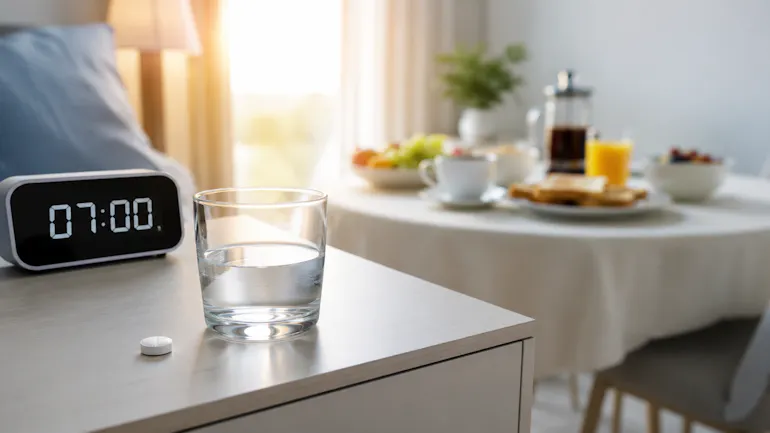
| 07:00 | Wake up. Take one tablet with ≤120 ml plain water. |
| 07:00 to 07:30 | Do not consume any food, coffee, tea, juice, or other drinks (except plain water). Do not take any other tablets, medicines, or supplements. |
| 07:30 | 30 minutes reached. Eat breakfast, have your coffee or other drinks, and take your other medicines and supplements as normal. |
Key takeaway:
There is no established clinical benefit to varying this routine. Food beforehand, a shorter wait, and larger water volumes have each been shown to reduce absorption. Other liquids have not been formally studied and are not included in the licensed instructions.
In practical terms, taking the tablet as directed helps support the intended semaglutide exposure. Individual absorption and treatment response can still vary.
Can you take the Wegovy pill with food?
Direct answer: No. The Wegovy tablet should be taken on an empty stomach in accordance with the licensed instructions. Trial data shows that food can substantially reduce absorption, and some participants had no measurable semaglutide in their bloodstream.
In the pivotal food-effect trial behind this instruction, healthy volunteers took oral semaglutide either after a high-fat, high-calorie breakfast or after an overnight fast. More than half the people who took oral semaglutide after food had no measurable drug in their bloodstream at all, 14 of 25 participants in the fed group, with the remaining 11 showing only limited exposure. Every participant in the fasting group had measurable drug levels.
Taking the tablet with breakfast may prevent it from being absorbed as intended. The Wegovy SmPC is direct: the medicine should be taken on an empty stomach after a fasting period of at least 8 hours, swallowed whole with a sip of water.
In practical terms, a single dosing error may reduce absorption that day, although the effect cannot be predicted for an individual. But if the tablet is regularly taken with breakfast, or regularly followed by coffee within a few minutes, you may be consistently absorbing less semaglutide than the licensed dosing regimen is intended to provide. If this happens repeatedly, speak to your prescriber or pharmacist, particularly if your treatment response seems lower than expected.
Why does food affect the Wegovy pill?
Direct answer: Semaglutide is a peptide, and peptides are broken down almost immediately by stomach acid and digestive enzymes. The Wegovy pill survives long enough to be absorbed because it's co-formulated with an absorption enhancer called SNAC, which locally raises stomach pH and helps the drug cross the stomach lining directly. Food changes the local chemical environment, dilutes SNAC's effect, and introduces competing contents in the stomach at exactly the moment semaglutide needs a clear window to be absorbed.
Semaglutide is a peptide, not a small-molecule drug. Most tablets, paracetamol, statins, blood pressure medicines, contain small molecules absorbed fairly predictably through the intestinal wall. Semaglutide is a peptide: a small protein, 94% structurally similar to your own natural GLP-1 hormone, and peptides are exactly what your digestive system is built to destroy. For an oral peptide medicine, that's the central problem, and it's why every GLP-1 receptor agonist before oral semaglutide (liraglutide, dulaglutide, injectable semaglutide itself) had to be given by injection instead, to bypass the stomach entirely.
SNAC is the tablet's workaround. The Wegovy pill (and Rybelsus, the lower-dose version licensed for type 2 diabetes) is co-formulated with SNAC, sodium N-(8-[2-hydroxybenzoyl]amino)caprylate, also called salcaprozate sodium. SNAC locally raises the pH around the dissolving tablet, briefly protecting semaglutide from enzymes, and helps it cross directly through the stomach lining, what researchers call transcellular absorption. This is unusual: most oral drugs are absorbed further down, in the small intestine. Semaglutide from the Wegovy pill is absorbed predominantly in the stomach itself, which is exactly why what's happening in the stomach at dosing time, food, water volume, other tablets, matters so much.
How absorption is meant to work:
Tablet swallowed
↓Dissolves in stomach
↓SNAC locally raises pH, creates a brief protective window
↓Semaglutide crosses the stomach lining directly (transcellular absorption)
↓Reaches the bloodstream
What food does to that process:
Food enters the stomach
↓Local pH shift from SNAC is diluted
↓Tablet competes with food contents for the same absorption window
↓Less semaglutide crosses the stomach lining in time
↓Lower blood levels
Even under ideal conditions, absorption is very low. Oral semaglutide's absolute bioavailability, the proportion of the dose that actually reaches the bloodstream, is estimated at roughly 0.8% when taken under the recommended conditions (fasting, ≤120ml water, 30-minute wait). Well over 99% of each dose is broken down and never reaches circulation. A drug with this little margin to begin with has almost no slack if conditions aren't right, unlike a small-molecule drug with 60% to 90% bioavailability, which can tolerate imperfect conditions more easily.
Why doesn't Novo Nordisk just increase the dose to compensate?
There are no published trials that directly answer this question. But mechanistically, the bottleneck isn't the amount of drug in the tablet, it's the size of the narrow, local absorption window SNAC creates in the stomach. Simply increasing the dose doesn't reliably translate into proportionally more drug absorbed, and higher unabsorbed amounts may not reliably improve exposure and could affect tolerability.
This is a genuinely interesting question most competing articles don't ask. If food cuts absorption so drastically, why not just put more semaglutide in the tablet and let some of it get lost? It's important to be upfront: this hasn't been tested as its own trial question, so what follows is mechanistic reasoning rather than a direct finding.
The honest, mechanistic answer is that oral semaglutide's absorption problem isn't really about quantity, it's about a narrow, local, time-limited process at the stomach wall. SNAC's protective pH shift only lasts briefly and only works in the immediate vicinity of the dissolving tablet, so more drug in the tablet doesn't create a larger or longer-lasting window for it to pass through. This is reasoning based on the underlying mechanism rather than a single trial finding, but it's consistent with why so much emphasis is placed on dosing conditions, fasting, water, timing, rather than simply prescribing a bigger tablet.
So what does this mean in practice? The fasting and timing rules are part of how the formulation is intended to achieve absorption.
What did clinical trials show?
Two Novo Nordisk trials, a food-effect trial and a "dosing conditions" trial, established the fasting, water volume, and waiting-time rules used today. Food before dosing left most participants with little or no measurable drug; a shorter-than-30-minute wait after dosing measurably reduced exposure; and water volume mattered less than fasting time, provided it stayed at or below 120ml.
Food versus fasting
Seventy-eight healthy adults were split into three groups: one ate a high-fat, high-calorie breakfast in the 30 minutes before dosing; one fasted overnight and continued fasting for 4 hours afterwards; a third "reference" group fasted overnight, then waited only 30 minutes after dosing before eating, mirroring standard patient instructions.
Food study takeaway: food can make absorption negligible. The fed group's results couldn't be included in the main statistical comparison because so many participants had no detectable drug in their blood. Fourteen of 25 had none at all; the other 11 had only limited exposure. Every fasting participant had measurable exposure.
30 minutes versus longer fasting
Comparing the 4-hour fasting group against the 30-minute reference group, both AUC (total 24-hour drug exposure) and Cmax (peak blood concentration) were around 40% higher with the longer wait. This particular comparison wasn't statistically significant, partly due to sample size and the naturally high variability in individual absorption, an important, honest caveat rather than proof either way.
The dosing-conditions trial: fasting duration, tested properly
A separate, larger trial in 161 healthy men tested combinations of water volume (50ml or 120ml) and post-dose fasting (15, 30, 60, or 120 minutes).
Timing study takeaway: 30 minutes is the evidence-based minimum wait. Both AUC and Cmax rose significantly with longer post-dose fasting, with the biggest single jump between 15 and 30 minutes. Absorption kept rising modestly up to 120 minutes, though with diminishing returns, one pharmacokinetic model estimated bioavailability at around 0.8% with the standard 30-minute wait, rising to a plateau near 1.4% by 120 minutes.
Why only plain water, up to 120ml?
Water study takeaway: small water volume is part of the absorption strategy, not just a comfort measure. Between 50ml and 120ml, this trial found no statistically significant difference. A separate imaging study (pharmacoscintigraphy, which tracks exactly where and how a tablet dissolves) found exposure around 40% lower with 240ml of water compared with 50ml.
The 120ml figure sits at the upper edge of the range shown not to reduce absorption: trials tested 50ml and 120ml as the "acceptable" range, while 240ml (roughly double) noticeably reduced exposure. A larger water volume likely dilutes the local SNAC effect, similar in principle to how food interferes, so 120ml (about half a glass) is the largest volume tested without a reduction, which is why it's the cap in the licensed instructions rather than an arbitrary round number.
Why doesn't coffee count as "water"?
Coffee, tea, and other drinks simply haven't been tested in the trials that established these instructions, only plain water was used. Because coffee and tea both introduce additional liquid volume and their own chemical content into the stomach at the same sensitive moment, the same reasoning that applies to food and excess water plausibly applies here too. This is inferred from the underlying mechanism rather than directly tested, which is why the confidence table above rates it "moderate" rather than "high", but it's also why the licensed instructions specify plain water only, rather than "any drink."
Why doesn't everyone absorb the tablet the same way?
Oral semaglutide absorption varies enormously between individuals, and even day to day in the same person, within-subject variability in bioavailability has been estimated at over 100%. Several factors plausibly contribute, based on the mechanism described above, though not all have been individually isolated and quantified in published trials: natural differences in stomach pH and acidity (affecting how much protection SNAC's local pH shift provides), how quickly the stomach empties, how precisely "fasting" was actually observed, other tablets or supplements competing for the same window, and simple unexplained day-to-day biological variability.
The SmPC explicitly warns prescribers that a lower-than-expected treatment response may reflect this natural variability, separate from whether instructions were followed. This is also a reason the instructions matter more here than for most tablets: when absorption is already this variable, controlling everything you can control, fasting, water, timing, is one of the only ways to keep your own exposure consistent from day to day.
Evidence at a glance
| Trial | What was investigated | Key finding | Patient takeaway |
|---|---|---|---|
| Food-effect trial (n=78) | Fed vs fasting vs 30-minute reference dosing | 14/25 in the fed group had no measurable drug; all fasting participants did | Food before dosing may substantially reduce absorption |
| Dosing conditions trial (n=161) | Post-dose fasting of 15, 30, 60 or 120 minutes | AUC and Cmax rose significantly with longer fasting, especially 15 to 30 minutes | Waiting under 30 minutes measurably reduces absorption |
| Dosing conditions trial (water arm) | Water volume of 50ml vs 120ml | No statistically significant difference | Up to 120ml of water is fine |
| Pharmacoscintigraphy study | Water volume of 50ml vs 240ml | ~40% lower absorption with 240ml vs 50ml | A full glass of water works against absorption |
What AUC and Cmax mean in plain English: AUC is the total drug exposure over a period, rather than the dose printed on the tablet. Cmax is the highest concentration the drug reaches in your blood. Both matter, because semaglutide's effects on appetite depend on sustained, adequate exposure, not just a brief spike.
Why do you need to wait at least 30 minutes?
Thirty minutes is the minimum wait shown in trials to give the tablet a meaningful window to be absorbed before food, drink, or other medicines disturb that environment. Waiting longer, up to around two hours, appears to help further, but with rapidly diminishing returns, which is why 30 minutes was set as the practical, evidence-based minimum in the phase 3 trials and the product licence.
The dosing-conditions trial directly compared 15, 30, 60, and 120-minute waits and found a clear, statistically significant increase in absorption as the wait lengthened, with the biggest jump between 15 and 30 minutes. That tells us two things: a 15-minute wait genuinely isn't long enough, and 30 minutes is a real, evidence-supported threshold rather than a rounded-up guess.
Does waiting longer increase absorption? The data suggests a modest increase, but the researchers themselves noted this has to be weighed against practicality, since this is a medicine taken daily, indefinitely. They drew a comparison with levothyroxine, a thyroid medicine also conventionally taken fasting and 30 minutes before food, which hasn't proven an unreasonable burden for patients long-term. Thirty minutes is the licensed, trial-tested minimum; there's no evidence patients need to extend the wait to hours for a clinically meaningful result.
In practical terms, a kitchen timer or phone alarm may help you follow the licensed 30-minute minimum.
Does taking the Wegovy pill correctly improve weight loss?
The phase 3 OASIS 4 trial, which supported the tablet's MHRA approval, used the standardised fasting, water, and 30-minute-wait protocol throughout. The reported 13.6% mean weight change therefore reflects outcomes under those trial conditions. This is an average trial result, not a guaranteed individual outcome. Trials haven't directly compared "correct" versus "incorrect" administration in terms of weight outcomes, but the SmPC states plainly that absorption is variable and adherence to the dosing regimen is recommended for optimal effect.
In OASIS 4, a 64-week trial in 307 adults with obesity or overweight plus a weight-related condition, participants assigned to the 25mg tablet had a mean body-weight reduction of 13.6% by week 64 in the intention-to-treat analysis, compared with around 2.2% to 2.4% with placebo. The mean reduction was 16.6% in the on-treatment analysis. Results varied between individuals. Every dose in that trial followed the same fasting and timing conditions covered in this article. The trial doesn't tell us how much less weight someone would lose by regularly ignoring the instructions, that specific comparison hasn't been run, but the SmPC's caution about variable absorption is a formal acknowledgement that non-adherence is a plausible cause of a weaker result.
Why is the Wegovy pill different from Wegovy injections?
The Wegovy injection delivers semaglutide directly under the skin, bypassing the stomach entirely, so food has no effect on it. The Wegovy pill has to survive the stomach and be absorbed there, which is why food, water volume, and timing all matter for the tablet but are irrelevant for the injection.
| Wegovy pill | Wegovy injection | |
|---|---|---|
| Food restrictions | Yes | No |
| Empty stomach required | Yes, at least 8 hours | No |
| Water limit | Yes, up to 120ml | No |
| Waiting time before food/drink | At least 30 minutes | None |
| Dosing frequency | Daily | Weekly |
| Route | Oral, absorbed in the stomach | Subcutaneous, bypasses the digestive system |
The injection route sidesteps the whole problem: semaglutide is absorbed gradually from under the skin into the bloodstream over the following days, with no stomach acid, no enzymes, and no competition from food. The tablet has no such shortcut, it must dissolve, briefly survive an acidic environment, and cross the stomach lining with SNAC's help, all within a narrow window before moving into the small intestine where absorption becomes far less efficient. Every instruction on the Wegovy pill's label exists to protect that window.
This also explains the dosing gap between formulations: because so much of each oral dose is lost to digestion, the tablet's maintenance dose (25mg) is far higher in milligram terms than the injection's (2.4mg), even though both aim to deliver broadly comparable ongoing exposure. The SmPC notes that switching between tablet and injection "cannot easily be predicted," because oral semaglutide shows considerably higher absorption variability than the injection, a direct consequence of the extra hurdles the oral route has to clear.
Bottom line: if you're on Wegovy injection, none of the food or timing rules in this article apply to you. They exist specifically because of the route the tablet has to travel through your body, a route the injection was designed to skip.
What changed when the MHRA approved the Wegovy pill?
Nothing about the dosing instructions was invented by pharmacies or written up independently after launch. The fasting, water, and 30-minute rules are identical to the conditions used throughout the OASIS 4 trial, and they're written directly into the licence the MHRA granted.
It's worth being explicit about this, because it's easy to assume that "take it on an empty stomach" is generic pharmacy advice, similar to guidance you might see for many everyday tablets. It isn't. The MHRA's approval announcement states the same 8-hour fast, water, and 30-minute conditions used in the trial that supported approval, and the SmPC, the legally binding product information that accompanies the licence, repeats them in section 4.2. In other words, every patient taking the Wegovy pill today is being asked to replicate, as closely as possible, the exact conditions under which the tablet was shown to work in the trial that got it licensed. That's a stronger basis than most "how to take your tablet" advice you'll find for other medicines.
How does this compare with Rybelsus?
The Wegovy tablet and Rybelsus contain the same active ingredient, semaglutide, and use SNAC to support absorption in the stomach. Follow the product-specific instructions supplied with the medicine. The licensed indication and dose differ between the products. Check the current patient information leaflet or speak to a pharmacist or prescriber for product-specific dosing information.
This is worth spelling out because the two are easy to confuse, and the underlying pharmacology is genuinely shared:
- Same active ingredient and absorption enhancer: both contain semaglutide, co-formulated with SNAC, relying on the same narrow stomach-absorption window.
- Similar administration principles: both products use oral semaglutide with SNAC, but patients should follow the current product-specific patient information leaflet and prescriber instructions.
- Different licensed purposes and doses: the products have different indications and dosing schedules. They should not be substituted or switched without prescriber guidance.
If you are switching between Rybelsus and the Wegovy tablet, follow your prescriber's instructions and the patient information leaflet supplied with the new medicine.
What happens if you eat too soon?
Eating or drinking before the 30-minute mark is likely to reduce how much semaglutide you absorb that day. Do not take an extra tablet to compensate. Resume your normal routine at the next scheduled dose, or speak to a pharmacist or prescriber if you are unsure.
Based on the dosing-conditions trial, a shorter wait, particularly under 15 minutes, is associated with meaningfully lower AUC and Cmax than the standard 30-minute wait. In practice, that day's dose may have delivered less semaglutide than usual. The individual effect cannot be predicted.
Do not take an additional tablet. Continue your normal schedule and take the next dose as planned, following the standard fasting and 30-minute rule. Seek advice from a pharmacist or prescriber if you feel unwell or are uncertain what to do. If eating too soon becomes a frequent pattern rather than an occasional slip, it's worth mentioning to your prescriber or pharmacist, particularly if your treatment response seems weaker than expected.
Myths vs facts
| Myth | Fact |
|---|---|
| "A coffee straight after doesn't really matter." | Coffee hasn't been formally studied with the tablet and isn't part of the recommended instructions, treat it the same as food and wait the full 30 minutes. |
| "More water is better, since it helps the tablet go down." | Trial data shows the opposite: a full glass (240ml) reduced absorption by around 40% compared with a small amount (50ml). |
| "Waiting 15 to 20 minutes is close enough to 30." | Trials found a clear, statistically significant drop in absorption below 30 minutes, with the biggest jump between 15 and 30 minutes specifically. |
| "If I mess it up, taking two tomorrow will balance it out." | Never double dose. The licence explicitly advises against taking more than one tablet a day to try to achieve a higher-dose effect. |
| "It's about avoiding nausea, like some other tablets." | The fasting rule is about absorption, not stomach comfort, it exists because of how the tablet is absorbed, not to reduce side effects. |
Common mistakes people make
| Common mistake | Likely consequence | Recommended action |
|---|---|---|
| Taking the pill with coffee or tea | Reduced absorption; these weren't used in the trials establishing these instructions | Use plain water only, up to 120ml |
| Taking it with fruit juice | Absorption has not been formally studied and may be reduced | Use plain water only |
| Taking vitamins or supplements alongside it | Multiple tablets taken together have been shown to reduce semaglutide's AUC by around a third | Wait at least 30 minutes before any other tablets, including supplements |
| Taking thyroid medication (e.g. levothyroxine) at the same time | Semaglutide has been shown to increase levothyroxine's total exposure by around 33% | Space doses out and flag concurrent use to your prescriber |
| Using more than a small sip of water | Larger volumes (around 240ml) have been linked to roughly 40% lower absorption compared with 50ml | Stick to up to half a glass (120ml) |
| Eating within 10 to 15 minutes of dosing | Clear, trial-demonstrated reduction in AUC and Cmax compared with a 30-minute wait | Wait a minimum of 30 minutes |
| Taking the tablet after breakfast rather than before | Likely to substantially reduce absorption, similar to the fed-state trial results | Take it first thing, before any food or drink |
| Crushing, splitting, or chewing the tablet | Effect on absorption unknown, not tested, and advised against on the licence | Swallow whole |
| Taking more than one tablet to "boost" the dose | Not supported by any trial evidence and explicitly advised against | Take only one tablet per day, as licensed |
What researchers still don't know
Being honest about the limits of the evidence is part of using it responsibly. None of the following have been formally tested as standalone conditions: sparkling water versus still water, black tea or coffee without milk, milk itself, protein shakes or supplement drinks, or lying down versus staying upright after dosing. In each case, the trials only tested plain water and full meals, so there's no direct evidence either way for these alternatives.
That's why the licensed instructions stay deliberately narrow, plain water only, up to 120ml, nothing else for 30 minutes, rather than researchers being overly cautious for no reason: the licence reflects exactly what was tested, no more and no less.
The bottom line
✓ Fast for at least 8 hours beforehand
✓ Plain water only, no coffee, tea, or juice
✓ Maximum 120ml of water
✓ Wait at least 30 minutes before food, drink, or other tablets
✓ If a dosing mistake happens, do not take an extra tablet
✓ Never double dose to make up for a mistake
Frequently asked questions
Can I drink coffee 15 minutes after taking Wegovy?
No. Fifteen minutes is well inside the 30-minute window shown in trials to matter, and coffee itself hasn't been formally tested, only water was used in the trials behind these instructions. Wait the full 30 minutes.
Can I brush my teeth first?
Brushing with water and toothpaste, without swallowing anything, isn't specifically restricted by the licence, which focuses on eating, drinking, and other oral medicines. If unsure, brush after the 30-minute window instead.
Can I take vitamins afterwards?
Yes, but only after the 30-minute wait, the same as any other oral tablet. A trial found that taking semaglutide alongside five other tablets reduced its absorption, which is why the SmPC advises waiting 30 minutes before any other oral medicinal products, including supplements.
Can I take Wegovy before bed instead of the morning?
The instructions are built around fasting state, not a specific clock time. As long as you've fasted at least 8 hours beforehand and can reliably avoid food, drink, and other tablets for 30 minutes afterwards, the time of day is flexible. For most people, first thing in the morning is simply the easiest way to guarantee both conditions.
Can I take it with tea?
No, tea, like coffee and juice, wasn't used in the trials establishing these instructions. The SmPC specifies water only.
Can I take the Wegovy pill with milk?
This has not been formally studied. Milk introduces additional liquid and nutrients into the stomach, so it may affect absorption. The licensed instructions specify plain water only, and milk falls outside what's been tested.
Can I drink water after taking Wegovy?
The instructions specify taking the tablet with up to 120ml of water at dosing, then waiting at least 30 minutes before drinking anything else, including further water, mirroring the trial protocols, where no additional liquid was permitted during the post-dose window.
Can I take Wegovy after breakfast?
This isn't recommended. In the food-effect trial, taking oral semaglutide after a meal resulted in no measurable drug exposure for over half of participants.
What happens if I accidentally eat after taking Wegovy?
Don't take an extra tablet to compensate. Continue as normal and take your next dose the following day, following the standard fasting routine. That day's dose was probably less well absorbed, but this is unlikely to cause a noticeable effect on its own.
What if I only waited 20 minutes?
Trial data suggests this reduces absorption compared with the full 30 minutes, though a single short wait on one day is unlikely to be noticeable. Return to the full 30-minute wait for future doses.
Should I wait longer than 30 minutes?
You can. Trial data suggests that absorption may increase with longer waiting periods up to around two hours, although the licensed minimum is 30 minutes. Follow the dosing instructions provided by your prescriber and in the patient information leaflet.
Does taking it with food make it less effective?
Very likely, yes. The food-effect trial found no measurable drug exposure in over half of participants who took oral semaglutide after a meal. This trial used healthy volunteers rather than patients on long-term treatment, but the underlying absorption mechanism is the same, and it's the direct basis for the "empty stomach" instruction.
Can I lie down afterwards?
Posture has not been established as a separate dosing requirement. Follow the patient information leaflet and ask a pharmacist or prescriber if you have concerns.
Does it matter what I eat after 30 minutes?
No medicine-specific food restrictions are stated after the 30-minute waiting period, provided the tablet has been taken as directed. General healthy-eating advice still applies for weight management, but that's separate from the absorption science here.
Who this article is for
This advice applies specifically to the oral Wegovy tablet (and, for the underlying absorption science, Rybelsus). It does not apply to Wegovy injections, which bypass the stomach entirely and have no food, water, or timing restrictions of this kind.
Sources
- Bækdal TA, Breitschaft A, Donsmark M, Maarbjerg SJ, Søndergaard FL. Effect of Various Dosing Conditions on the Pharmacokinetics of Oral Semaglutide, a Human Glucagon-Like Peptide-1 Analogue in a Tablet Formulation. Diabetes Therapy. 2021;12:1915 to 1927.
- Bækdal TA, et al. Clinical Pharmacokinetics of Oral Semaglutide: Analyses of Data from Clinical Pharmacology Trials. Clinical Pharmacokinetics. 2021.
- Buckley ST, Bækdal TA, Vegge A, et al. Transcellular stomach absorption of a derivatized glucagon-like peptide-1 receptor agonist. Science Translational Medicine. 2018;10:eaar7047.
- Bækdal TA, Donsmark M, Hartoft-Nielsen ML, Søndergaard FL, Connor A. Relationship between oral semaglutide tablet erosion and pharmacokinetics: a pharmacoscintigraphic study. Clinical Pharmacology in Drug Development. 2021;10:453 to 462.
- Wharton S, Lingvay I, Bogdanski P, et al. Oral semaglutide 25 mg in adults with overweight or obesity (OASIS 4). New England Journal of Medicine. 2025;393(11):1077 to 1087.
- Wilding JPH, Batterham RL, Calanna S, et al. Once-Weekly Semaglutide in Adults with Overweight or Obesity (STEP 1). New England Journal of Medicine. 2021;384:989 to 1002.
- Hausner H, Derving Karsbøl J, Holst AG, et al. Effect of oral semaglutide on the pharmacokinetics of thyroxine after dosing of levothyroxine and the influence of co-administered tablets on the pharmacokinetics of oral semaglutide in healthy subjects. Expert Opinion on Drug Metabolism & Toxicology. 2021;17(11):1355 to 1364.
- Wegovy 25 mg tablets, Summary of Product Characteristics. Novo Nordisk Limited. Electronic Medicines Compendium (emc).
- Rybelsus 3 mg Tablet, Summary of Product Characteristics. Novo Nordisk Limited. Electronic Medicines Compendium (emc).
- US Food and Drug Administration. RYBELSUS (semaglutide) tablets, full prescribing information. accessdata.fda.gov.
- Medicines and Healthcare products Regulatory Agency. First GLP-1 tablet for weight loss approved in the UK. GOV.UK, 11 June 2026.
This article is intended for general information and does not replace advice from a prescriber or pharmacist. Individual response to oral semaglutide varies, and anyone with questions about their own treatment should speak to the Medino clinical team or their prescriber.
