
How to Get Rid of Warts: The Best Pharmacy Treatments Explained
At a glance
- Best treatment: Salicylic acid
- Typical treatment time: Up to around 12 weeks
- Suitable for: Most common warts and verrucas
- See a pharmacist or GP if: it's on the face or genitals, you're unsure it's a wart, you have diabetes or poor circulation, or it hasn't improved after a full course
Among over-the-counter treatments, salicylic acid has the strongest evidence for improving wart clearance, which is why it's usually the first thing a pharmacist will suggest for a straightforward hand wart or verruca. It's inexpensive and works for most people when used correctly and consistently - but it isn't fast. Expect several weeks, not days, and understand that no OTC treatment works for everyone. Home freeze kits are an appropriate alternative if you'd rather not commit to a daily routine, though the evidence for consumer freezing products specifically is less robust than for salicylic acid. If the wart is on your face or genitals, doesn't look like a typical wart, or you have diabetes or a circulation problem, don't self-treat - speak to a pharmacist first.
What is the best wart treatment?
For most common warts and verrucas, salicylic acid performs comparably in some trials and better in others, particularly for hand warts, but requires clinic visits. Home freeze kits are a reasonable middle ground, though less well studied than salicylic acid.
Which wart treatment is right for you?
Rather than guess, it helps to work through it step by step. This decision tree covers the main things a pharmacist would ask before recommending a treatment:
Follow these steps before choosing a treatment.
1. Are you sure it is a wart?
If you are unsure, ask a pharmacist to check it before starting treatment.
2. Is it on your face or genitals?
Do not self-treat warts in these areas. Speak to a pharmacist or GP.
3. Do you have diabetes, poor circulation or reduced sensation?
Ask a pharmacist or GP before using a wart treatment.
You should also seek advice before treatment if you are pregnant or breastfeeding.
4. Is it a small, relatively new wart?
A salicylic acid treatment may be a suitable first option. It usually needs to be applied every day and may take up to 12 weeks to work.
Always follow the instructions supplied with the product.
5. Is it large, long-standing or difficult to treat?
You can still consider salicylic acid, but it may be helpful to ask a pharmacist whether another option, such as cryotherapy, is appropriate.
6. Has it improved after a full course of treatment?
- Yes: Continue or stop treatment according to the product instructions.
- No: Speak to a pharmacist or GP for further advice.
Seek medical advice sooner if the area becomes very painful, bleeds repeatedly, changes appearance or you are no longer sure that it is a wart.
This is general guidance only. Always read the product instructions and speak to a pharmacist if you are unsure.
Wart treatments compared
| Treatment | Best for | Evidence | Typical treatment time | Main limitation |
|---|---|---|---|---|
| Salicylic acid | Most hand warts and verrucas | Strongest OTC evidence | Up to 12 weeks | Daily application required |
| Professional cryotherapy | Stubborn hand warts | Good evidence, particularly for common warts | Several clinic visits | Not routinely available on every NHS service |
| Home freeze kits | People who'd prefer less frequent treatment | Limited OTC-specific evidence | Several weeks | More uncomfortable |
| Watchful waiting | Mild, painless warts | Natural resolution | Months to around two years | Slow, and not guaranteed |
Do I need to treat it at all?
Around two-thirds of warts in children clear up on their own within about two years, without any treatment, as the immune system eventually deals with the underlying virus (HPV). There's no reliable way to predict how quickly this will happen for any individual wart - a question we're asked every week by people who assume every wart must be treated.
Treatment is worth considering if the wart is:
- Painful, especially on a weight-bearing part of the foot or a heavily-used part of the hand
- Spreading, or new warts are appearing nearby
- Bleeding or catching on clothing, tools, or bedding
- Cosmetically bothersome
- Interfering with daily activities
If none of these apply, waiting is a reasonable choice, particularly for young children - our children's wart treatment guide goes into age-specific considerations in more depth.
Is it actually a wart?
Before trying any wart removal treatment, it's worth checking the diagnosis, since these treatments are mildly destructive to skin and aren't right for every type of lesion. One of the most common mistakes we see at the pharmacy counter is someone treating a corn or callus for weeks with no effect, simply because it looked "wart-like."
Typical signs of a common wart or verruca:
- A rough, grainy, cauliflower-like surface
- Interruption of the normal skin lines and fingerprint-like ridges
- Small black or brown dots on the surface (tiny clotted blood vessels - not "roots"; despite the popular myth, warts don't have roots in the way the term suggests)
- Most common on the hands, fingers, and soles of the feet
- Usually painless unless on a pressure point - a verruca on the sole can feel like standing on a small stone
What it might be instead: corns and calluses (thickened skin from pressure or friction, without the black dots or broken skin lines of a wart), skin tags (soft, often stalked, unlike a wart's firm rough surface), or molluscum contagiosum (small, smooth, pearl-like bumps, often with a central dimple - our separate molluscum contagiosum guide covers this in detail). Our guide to warts vs corns and calluses goes through the differences in more detail.
If you're not confident it's a wart - or it's changing shape, growing quickly, bleeding without an obvious cause, or looks unusual in any way - get it checked before treating it.
Do not self-treat if any of the following apply
- The wart is on the face, eyelids, or genital or anal area
- It's on a mole, birthmark, or broken, infected, or inflamed skin
- You aren't confident it's actually a wart
- You have diabetes, poor circulation, or reduced sensation in the area
- You have a weakened immune system, including through certain medications
- You are pregnant or breastfeeding - check the product leaflet and ask a pharmacist, as suitability can vary by product and treatment site
In any of these situations, speak to a pharmacist or GP before buying a wart treatment.
Which treatment would a pharmacist recommend first?
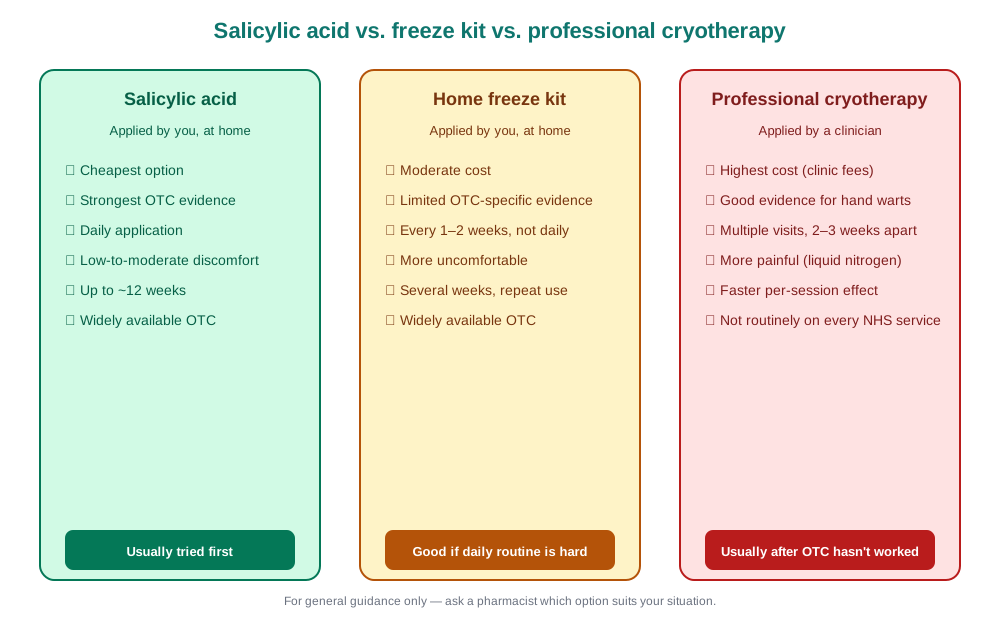
For most straightforward hand warts and verrucas, a pharmacist will usually suggest trying a salicylic acid wart removal treatment first. It has the strongest evidence base of any OTC option, is inexpensive, and is suitable for most people when used correctly. A freeze kit is an appropriate second choice, particularly for anyone who knows they won't keep up a daily routine. Professional cryotherapy is generally reserved for warts that haven't responded to a full course of self-treatment, or for people who aren't suitable for self-treatment in the first place.
Salicylic acid: how it works and how to use it
For a closer look at the ingredient itself, including how it's formulated across different products, see our dedicated salicylic acid guide. If your wart is specifically on the sole of the foot, our verruca treatment guide covers a few foot-specific practicalities not repeated here.
How it works
Salicylic acid is a keratolytic - it gradually softens and breaks down the thickened skin that makes up the wart, while mildly irritating the area in a way that's thought to help support the immune response against the underlying virus. A Cochrane review pooling data from a large number of trials found salicylic acid clearly increased wart clearance versus placebo, though it described the benefit as modest, with results varying across trial sites, formulations, and treatment length. In practical terms: it improves your odds of clearing a wart, but it's not a guaranteed or fast fix.
Who it's best for
Most common warts and verrucas on the hands, fingers, and feet, in people without diabetes, poor circulation, or reduced sensation. Not suitable for facial warts or warts near the eyes or genitals.
How to apply it
Always follow the specific product's instructions, as strength, frequency, and maximum course length vary between products.
- Soak the wart in warm water for a few minutes to soften the surrounding skin.
- Dry the area thoroughly - applying to damp skin dilutes the treatment.
- When the product instructions recommend it, gently remove loose dead skin with an emery board or pumice stone kept specifically for this purpose. Don't file until the skin is sore or bleeding, and don't share the file or use it elsewhere on your body.
- Apply accurately to the wart itself, avoiding surrounding healthy skin, which salicylic acid will also irritate.
- Cover if the product recommends it, and repeat as directed - typically daily.
Common mistakes
One of the most common reasons treatments fail is stopping too early - often around week two or three, right before enough time has passed for visible change to appear. Other frequent mistakes include:
- Picking or scratching the wart, which can spread the virus to nearby skin
- Applying inconsistently rather than as regularly as directed
- Filing too aggressively, causing bleeding rather than gently removing loose dead skin
- Getting the treatment onto surrounding healthy skin - if this happens, wipe off any excess promptly and rinse the area with water; occasional contact isn't usually serious, but repeated contact can irritate healthy skin unnecessarily
Side effects
Mild irritation, stinging, or redness can occur during treatment, but this isn't necessary for the treatment to be working and shouldn't be read as a sign of progress either way. Stop temporarily and seek advice if the area becomes very sore, inflamed, broken, or shows signs of infection - a brief pause of a few days before restarting is reasonable if a wart becomes uncomfortably sore.
When to stop
Most salicylic acid products are licensed for use up to around 12 weeks, depending on the product. If there's no improvement at all after a full, correctly-applied course, ask a pharmacist to check the diagnosis and technique rather than continuing beyond the period stated on the leaflet.
Home wart-freezing kits
How they work
Over-the-counter freezing kits cool the wart using a refrigerant delivered through an applicator, spray, or pen. They don't reach the extremely low temperatures used in professional cryotherapy with liquid nitrogen, so results can be less predictable. Preparation, frequency, and course length vary by product - always follow the instructions included.
How they differ from professional cryotherapy
A GP, nurse, or podiatrist applies liquid nitrogen, substantially colder than consumer freeze sprays. The Cochrane evidence on cryotherapy relates mainly to this professional treatment and doesn't establish that OTC freeze kits work equally well.
Who they suit
If you know you'll find a daily routine difficult to keep up, and you don't have thin or sensitive skin, diabetes, or circulation problems, a freeze kit can be a reasonable fit.
Discomfort and combining treatments
Freezing causes a burning or stinging sensation during and shortly after application, and can cause blistering over the following day or two - generally more uncomfortable than salicylic acid, particularly for children. Don't apply salicylic acid and a home freeze kit to the same area on the same day; ask a pharmacist first if you're considering combining approaches.
Choosing a wart removal product
Patients often stand in front of the shelf and ask us the same handful of questions, so it's worth answering them properly rather than just listing formats.
Should I choose a liquid, gel, paint, or plaster?
Liquids and "paints" (such as Salactol, which combines salicylic acid with lactic acid) tend to suit small, well-defined warts on the fingers or hands, where precise, controlled application matters. They dry to a film over the wart.
Gels (such as Bazuka Gel) are often easier to control on awkward or curved surfaces than a liquid, and some form a water-resistant barrier over the wart once dry, which can help stop the infection spreading and means a plaster isn't always necessary.
Medicated plasters (such as certain Scholl verruca plaster systems) keep the treatment in continuous contact with the wart, which suits people who find it hard to apply a liquid or gel accurately, or who want a "set and forget" format between applications. They can be harder to fit neatly on fingers or irregularly shaped areas.
Freeze pens and sprays (such as Scholl's verruca and wart pen, or aerosol freeze treatments) suit you if you know you'll struggle to remember a daily application and can tolerate more discomfort in exchange for a less frequent routine. Our guide to professional cryotherapy explains how the clinic version compares if a home freeze kit doesn't clear things up. If you have diabetes or circulation problems, our diabetes and foot care guide covers wart and skin care specific to those conditions.
Should I choose a lower or higher strength salicylic acid?
Over-the-counter salicylic acid products commonly range from around 12% up to 26% (some prescription-strength products go higher still). Lower-strength products (around 12%) tend to be gentler and are often a sensible starting point, particularly on more sensitive skin or for first-time use. Higher-strength products (up to 26%) are generally aimed at thicker, more established warts and verrucas, and can act faster on stubborn areas, but carry a higher risk of irritating surrounding skin if applied imprecisely. If you're not sure which strength suits your situation, ask a pharmacist - this is exactly the kind of question we're happy to help with in person.
A quick reference
| Product format | Best suited to | Main drawback |
|---|---|---|
| Liquid or paint (e.g. Salactol) | Precise application to small warts | Needs regular, careful daily application |
| Gel (e.g. Bazuka) | Awkward or curved surfaces | Can spread onto surrounding skin if not applied carefully |
| Medicated plaster (e.g. Scholl verruca plasters) | Keeping treatment in continuous contact | May not suit fingers or irregular areas |
| Freeze pen or spray (e.g. Scholl verruca pen, aerosol freeze kits) | Less frequent application | More uncomfortable; OTC-specific evidence is thinner |
Product names are given as examples of common formats available in UK pharmacies, not a recommendation of one brand over another - check current stock and patient information leaflets before purchase. You can browse Medino's range of wart and verruca treatments to compare formats and strengths.
Whatever you choose, check the product's age guidance, salicylic acid strength, and maximum recommended course length before buying.
Five pharmacist tips that improve your chances of success
- Be patient. Most treatments fail because people stop too early, not because the product doesn't work.
- Protect the surrounding skin. A little petroleum jelly around (not on) the wart can help reduce irritation to healthy skin.
- Don't pick at it. Picking or scratching can spread the virus to nearby skin.
- Don't share nail files, pumice stones, or towels with anyone else, and don't reuse a wart-specific file elsewhere on your own body.
- Track it every couple of weeks. Progress is gradual - checking every two weeks (rather than daily) makes small changes easier to notice and keeps expectations realistic.
What does a wart look like when it's clearing?
This is one of the most common things people ask us once they're partway through treatment, and it's a fair question - early progress can be subtle.
Signs a wart is genuinely responding to treatment include:
- The surface becoming flatter rather than raised
- The wart getting smaller overall
- The black dots becoming less visible or disappearing
- Normal skin lines gradually reappearing through the area
- Some peeling, and sometimes a whitish, softened appearance in the days after application, as the treated tissue is shed - this is a normal short-term effect of the treatment working on the surface, not a sign of infection
What doesn't confirm progress is redness or irritation around the wart - that shows the product has affected the skin, not that the wart itself is clearing.
How to stop a wart spreading
Warts spread through direct skin contact and via contaminated surfaces - our are warts contagious? guide covers transmission in more depth - so a few simple habits make a real difference while you're treating one:
- Avoid picking or scratching the wart, which can carry the virus to nearby skin.
- Don't share towels, nail files, socks, or shoes with other people while a wart or verruca is present.
- Cover it with a waterproof plaster in shared spaces such as swimming pools, gym changing rooms, or communal showers.
- Dry hands and feet thoroughly, especially between toes, since the virus spreads more easily on damp skin.
- Keep a dedicated file or pumice stone for the wart, and don't use it elsewhere on your body afterwards.
None of these guarantee you won't pass it on or develop a new wart elsewhere, but together they meaningfully reduce the risk.
How long does wart treatment take?
Set realistic expectations from the outset - most people who give up on a treatment do so because they expected faster results than the evidence supports.
- Early weeks: Visible change is often minimal.
- Several weeks in: Some responsive warts begin to soften, flatten, or shrink at the edges.
- Towards the end of a full course (often up to around 12 weeks, depending on the product): some warts clear fully within this period; others persist despite correct, consistent treatment.
Recurrence: Warts and verrucas can come back, or new ones can appear nearby, even after a treated one has cleared. Not sharing files or towels, and avoiding walking barefoot in communal wet areas, are sensible everyday precautions, though they aren't proven to guarantee against recurrence.
What happens if wart treatment doesn't work?
If you've completed a full, correctly-applied course and the wart hasn't budged, a few things are worth considering before assuming the wart simply "won't go":
- The diagnosis might be wrong. Corns, calluses, and other skin lesions don't respond to wart treatments in the same way - a pharmacist can double-check.
- Not enough time has passed. Thick or long-standing warts often take longer than the average course.
- Technique may need adjusting. Inconsistent application or insufficient removal of dead skin before each application are common, fixable reasons for slow progress.
- The immune response may simply be slower for that individual wart - this varies considerably between people and isn't a sign anything's being done wrong.
- Referral may help. A GP can reassess and discuss further options, including professional cryotherapy where locally available, or other treatments not sold over the counter. It's worth knowing that cryotherapy for uncomplicated warts isn't routinely available through every NHS service, so provision varies by area.
A wart that keeps coming back after seeming to clear is common and doesn't necessarily mean anything has gone wrong with treatment - it usually just reflects how the underlying virus behaves.
Home remedies and treatments with limited evidence
Several remedies for how to remove a wart at home circulate widely online but aren't well supported by good-quality trial evidence, and some carry a real risk of skin irritation:
- Apple cider vinegar: No good-quality evidence it clears HPV-related warts, and repeated use of its acidity can cause chemical burns.
- Garlic: No reliable clinical evidence supports it, and raw garlic applied directly to skin can cause irritation or burns.
- Banana peel and toothpaste: No evidence base beyond anecdote.
- Tea tree oil: No solid evidence it clears HPV warts specifically, and it can cause skin sensitisation in some people.
- Duct tape occlusion: Studied more than most home remedies, but trials have shown mixed results, with some finding no significant advantage over placebo. Generally low risk, though adhesives can irritate skin or cause maceration with prolonged use, so it shouldn't be relied on as a sole treatment.
If you're wondering whether wart removers actually work at all when so many home remedies don't - the answer is that the licensed, evidence-based options (salicylic acid and cryotherapy) do have real, trial-backed support; it's specifically the unlicensed home remedies above where the evidence is weak.
None of these should replace salicylic acid or professional advice, and none should be used on broken skin, the face, or genital area.
When to ask a pharmacist or GP
- You're not confident it's actually a wart
- It's on the face, near the eyes, or in the genital or anal area
- It's changing rapidly, growing quickly, or looks unusual
- It's bleeding persistently or unusually painful
- You have diabetes, poor circulation, or a weakened immune system
- You're pregnant or breastfeeding and unsure about a product's suitability
- The wart has persisted despite a full, correctly-applied course
- You're treating a young child and are unsure of the diagnosis
A GP or pharmacist can confirm the diagnosis and talk through further options, including whether professional cryotherapy is available locally.
Frequently Asked Questions
What is the fastest way to get rid of a wart?
There's no shortcut backed by good evidence - most effective treatments need several weeks of consistent use, and there's no reliable basis for expecting overnight results from any over-the-counter wart remover.
What kills a wart permanently?
No treatment guarantees permanence, because the underlying virus can persist in nearby skin even after a wart clears. Salicylic acid and cryotherapy have the best evidence for clearing the visible wart, but recurrence is always possible.
Can you pull a wart out?
No. Warts don't have roots that can be pulled, and attempting this can cause bleeding, pain, infection, and can spread the virus to surrounding skin.
Does a wart have roots?
No - this is a common myth. The black dots sometimes visible in a wart are tiny clotted blood vessels, not roots, and the wart itself is confined to the outer layer of skin.
Can you pop a wart?
No. Warts aren't fluid-filled in the way spots or blisters are, so there's nothing to "pop," and trying to do so risks bleeding, infection, and spreading the virus.
Why is my wart white after treatment?
A whitish, softened appearance in the day or two after applying salicylic acid is a normal effect of the treatment breaking down the outer layer of skin. It usually isn't a sign of infection, but if the area becomes very sore, swollen, or shows other signs of infection, seek advice.
What happens if wart remover touches healthy skin?
Occasional contact usually just causes mild, short-lived irritation - wipe off any excess and rinse with water. Repeated contact with surrounding skin can cause more noticeable irritation, which is why accurate application matters.
Is freezing better than salicylic acid?
Neither is clearly superior across all situations - evidence varies by wart location and study, and professional cryotherapy differs meaningfully from consumer freeze kits. Salicylic acid has the more consistent evidence base for self-treatment.
Can you cut a wart off?
No. Cutting a wart yourself risks bleeding, infection, scarring, and can spread the virus to surrounding skin. Any surgical removal should only be carried out by a healthcare professional.
Why does my wart keep coming back?
Warts can recur, or new ones appear nearby, even after a treated one has cleared, because the underlying virus can persist in the skin. This is common and doesn't necessarily mean treatment was done incorrectly.
Can children use wart treatments?
Many salicylic acid products are suitable for children, though strength and application should follow the product's specific age guidance - check with a pharmacist if unsure. Many childhood warts also clear on their own, so treatment is often optional.
When should I stop self-treating and get it checked?
If it hasn't cleared after a full, correctly-applied course, if it's changing, bleeding, or unusual in appearance, or if you have diabetes, poor circulation, or a weakened immune system and haven't yet had it assessed.
Key takeaways
- Most warts are harmless, and many clear up without any treatment at all.
- Salicylic acid is usually the best first treatment for straightforward hand warts and verrucas.
- Consistency matters more than strength - daily use for the full course beats occasional stronger applications.
- Most treatments take weeks, not days; set expectations accordingly.
- If you're unsure it's a wart, or you're in a higher-risk group, ask a pharmacist before starting treatment.
References
- NICE Clinical Knowledge Summaries - Warts and verrucae: prescribing information, topical salicylic acid
- Cochrane - Topical treatments for skin warts
- British Association of Dermatologists - Viral warts: patient information for parents and young people
This article provides general information and is not a substitute for individual medical advice. If you're unsure whether a skin lesion is a wart, or you fall into one of the higher-risk groups described above, speak to a pharmacist or GP before starting treatment.
