Oral GLP-1 vs Injections: What's Actually Different About Taking Foundayo as a Tablet
A Foundayo tablet and a Wegovy or Mounjaro injection end up doing broadly the same job, but almost nothing about actually taking them day to day is the same. Foundayo (orforglipron) needs no fridge, no needle and no injection technique. It does need a daily habit that a once-weekly injection doesn't. This page sets out exactly what changes and what doesn't - practically, not clinically - so you can judge for yourself whether the difference actually matters to you.
Key takeaways
- Foundayo is swallowed once a day; Wegovy and Mounjaro are injected once a week - a genuinely different rhythm, not just a different device.
- Foundayo has one storage rule - stay in the pack it's dispensed in, out of direct light; Wegovy and Mounjaro pens each have their own numbered fridge and temperature rules, and the two aren't identical to each other.
- There's no injection technique to learn and no needle to manage with a tablet - but a daily dose is its own thing to remember, and that's a real trade-off, not a small one.
- Missed-dose handling differs in shape, not just frequency: a tablet's catch-up rule is the same whenever you remember it; a weekly injection builds in a several-day window before you have to skip it.
- Neither format is straightforwardly "better." Which one suits you depends on your own routine and what you're more likely to forget - not on the medicine itself.
What "oral GLP-1" actually means
GLP-1 medicines all act on the same hormone pathway, but they're not all built the same way. Wegovy (semaglutide) and Mounjaro (tirzepatide) are peptides - larger molecules that break down in the stomach, which is why they have to be injected. Orforglipron, the active substance in Foundayo, is a smaller, non-peptide molecule that survives digestion, which is why it can be a swallowed tablet instead. For the fuller explanation of how orforglipron works and how the three medicines compare, see Medino's complete Foundayo overview.
Storage and travel
Foundayo's storage instruction is short: it's light sensitive, so it needs to stay in the pack it's dispensed in rather than being decanted into a pill box. The current UK patient information leaflet gives no temperature range and no fridge requirement at all. Dispensed in blister packs of 30 or 90 tablets, it behaves like most other tablets in a bathroom cabinet.
Wegovy and Mounjaro pens are different from Foundayo, and from each other. A new Wegovy pen needs refrigerating (2–8°C) before use; once opened, it can be kept below 30°C outside the fridge for up to six weeks before it must be thrown away, used or not. A Mounjaro pen also needs refrigerating before first use, but its in-use window is shorter - up to 30 days below 30°C, not six weeks. The two figures aren't interchangeable, so check rather than assume one injectable's rules match the other.
Practically, that means travelling with Foundayo involves no cool bag, no fridge-space negotiation in a hotel room, and no clock running on a pen you've already opened.
A quick note on needles and sharps
There's a smaller difference too. Injectable GLP-1s use single-use needles that must be disposed of safely after every injection - never reused, never left attached to the pen. A tablet doesn't create that chore. It's a small thing on its own, but if you already manage a sharps bin for another medicine, it's genuinely one fewer to think about.
Discretion and daily routine
A tablet can be taken almost anywhere, in a few seconds, without anyone else needing to know. That's real. Travel and fridge logistics specifically come up as reasons people give for being interested in an oral GLP-1 option, per individual, non-representative accounts on Medino's feature on why people are interested in Foundayo - worth reading as personal perspectives, not as evidence that a tablet suits most people better.
But "more discreet" isn't automatically true just because nothing is injected. A weekly injection is a single, brief, private event once every seven days. A daily tablet is seven small events instead of one - usually easier to slot into an existing routine, but not obviously less noticeable if you share a bathroom cabinet or take medicines in front of family each morning. Which one actually feels more private tends to depend on your own week, not on the format itself.
For a broader picture of what daily life on Foundayo can look like beyond the format question - appetite, eating patterns, how it settles into a routine over time - see Medino's account of how people describe daily life changes on Foundayo.
No injection technique, no needle anxiety - but that's not the whole story
Needle anxiety is a real, common reason some people are specifically interested in an oral GLP-1 option, and it's worth naming plainly. If self-injecting is something you actively dread, a tablet avoids that specific concern: no technique to learn, no needle to prepare, no injection site to choose between.
It's worth being accurate about the flip side, though. Injection technique itself isn't especially difficult once someone's been shown it once or twice - Wegovy's and Mounjaro's own instructions are designed to be self-taught, with a dose window built into each pen that confirms the injection has gone in. For most people, the mechanics stop being an obstacle within the first couple of doses; where anxiety exists, it's usually about the needle itself, not the process of using the pen.
The trade-off: daily tablet vs weekly injection
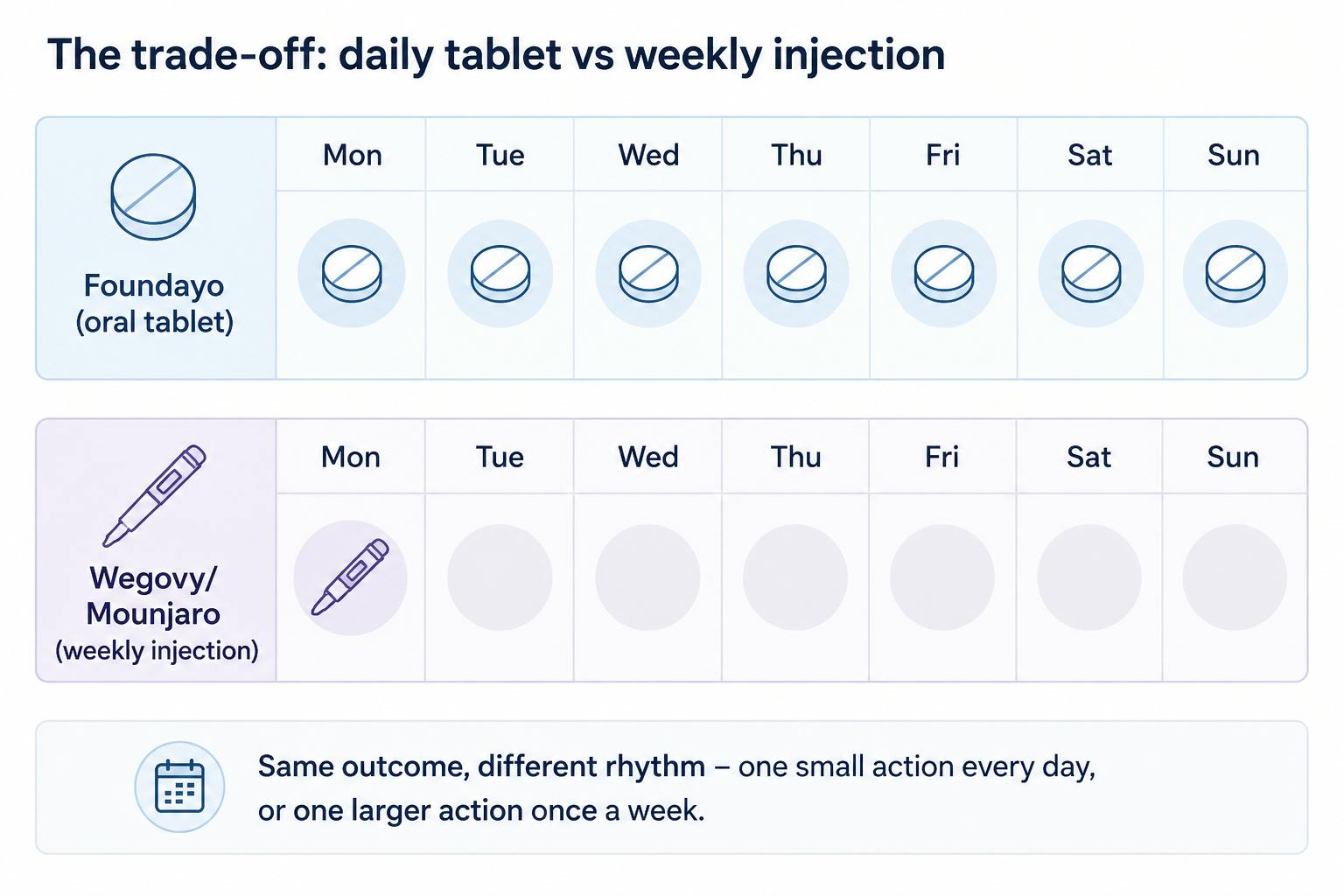
This is the part that's easy to gloss over: taking Foundayo means remembering it every single day, indefinitely, while Wegovy and Mounjaro only ask for a decision once a week. For some people, a daily habit is genuinely easier to keep than a weekly one - it becomes automatic, tied to something else already done every day, like brushing your teeth. For others, it's the opposite: a weekly injection, marked on a calendar or flagged by a phone reminder, is one decision to remember instead of seven.
Pharmacist insight: when someone's weighing up format, the more useful question usually isn't "do I mind injections" - it's "what do I actually forget: the things I do every day, or the things I only do once a week?" Someone who reliably takes a daily multivitamin or contraceptive pill tends to manage a daily tablet fine. Someone who's better at a weekly ritual, like putting the bins out, often does better with a weekly injection instead. -Alessandro Grenci, Superintendent Pharmacist at medino
One real account on Medino's feature on why people are interested in Foundayo specifically found weekly injections more convenient than a daily tablet - a reminder that "no more injections" doesn't land the same way for everyone.
There's a genuine structural difference too, checked directly against all three medicines' current UK leaflets: if a dose is missed, the "catch-up" window is shaped differently depending on format. With Foundayo, the instruction is the same whenever you remember: take it as soon as you do, then carry on as normal - Medino's missed-dose page covers this in full. With Wegovy, if it's five days or less since the missed injection, you use it as soon as you remember; beyond that, you skip it and wait for the next scheduled day. Mounjaro works the same way, with a four-day threshold instead of five. A weekly format effectively builds in a several-day forgiveness window; a daily format resets every 24 hours instead.
As an illustration: someone who travels for work most weeks might value not planning around fridge access or carrying a pen through security, and find a daily tablet easier to keep consistent on the road. Someone with a fixed, unchanging home routine might find the opposite - one weekly injection fits their week with less to actively remember overall. Neither preference is more valid than the other.
Which format people actually stick with for longer isn't something this project found dedicated UK research on - the forgiveness-window point above is a logical consequence of each format's own rules, not a studied result on real-world adherence.
For the exact Foundayo dosing schedule this trade-off assumes - how the dose changes over time and how often - see Medino's dosing and titration guide.
Quick reference: what changes, what doesn't
| Foundayo (tablet) | Wegovy / Mounjaro (pen) | |
|---|---|---|
| How often | Once daily | Once weekly |
| Storage | Original packaging, away from light - no fridge or temperature rule | Fridge (2–8°C) before first use; limited weeks/days unrefrigerated once opened, varies by product |
| Technique | Swallow whole | Self-inject with a single-use needle |
| Sharps | None | Needle disposal after every dose |
| Missed dose | Same-day catch-up, whenever remembered | Several-day catch-up window, then skip to next scheduled day |
| Travel prep | None beyond usual medicine care | Cool-bag/fridge planning; sharps handling |
Is one format "better"? A balanced close
No - not in any way that holds for everyone. A tablet removes injections, fridge storage and needle handling. A weekly injection removes the need to remember something every day. Both are licensed to the same UK standard, and neither is inherently easier; they're just differently shaped.
If you're already being treated with an injectable GLP-1 medicine and are specifically weighing a change to Foundayo, Medino's switching guide covers what that conversation with a prescriber typically involves. If you'd rather work through your own priorities in a structured way before any consultation, questions to ask before starting Foundayo is built for exactly that. And for the full picture of what Foundayo is, how it's licensed, and where things currently stand in the UK, start with Medino's full Foundayo overview.
Frequently asked questions
Is Foundayo actually easier to take than an injection?
Not universally. It removes injections, needles and fridge storage, which some people find much easier. But it adds a daily habit a weekly injection doesn't require, which some people find harder to keep up. Which is genuinely easier depends on your own routine and what you're more likely to forget, not on the medicine itself.
Do I need to keep Foundayo in the fridge?
No. Foundayo's current UK patient information leaflet has one storage instruction: it's light sensitive, so it needs to stay in its dispensing pack. There's no fridge requirement or temperature range stated, unlike Wegovy and Mounjaro pens, which both need refrigeration before first use.
Can I take Foundayo through airport security or on a flight without any special preparation?
Foundayo doesn't need refrigeration or sharps handling, so it avoids the cool-bag planning and needle declaration an injectable GLP-1 can involve. It's still sensible to carry it in its dispensing pack with your prescription details to hand, as you would with any regular medicine when travelling.
