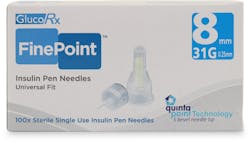
GlucoRx CarePoint Insulin Pen Needles 5mm 31G 100 Pack

GlucoRx CarePoint Insulin Pen Needles 5mm 31G 100 Pack
All sizes
What 500,000+ customers say about medino:
Description
GlucoRx CarePoint Insulin Pen Needles 5mm 31G 100 Pack are single-use pen needles for injecting insulin with an insulin pen. They have a 5mm length, a 31G gauge and a 3 bevel needle tip, and fit all insulin pens, so the same needle can be used whichever pen you have.
Key Features
- 5mm length, 31G gauge: These are 5mm needles in a 31G gauge. Your healthcare team should help you choose the most suitable needle length.
- 3 bevel needle tip: The tip is sharpened with 3 bevels, which GlucoRx explains is the angled surface created when a needle tip is sharpened to help it glide through the skin.
- Universal fit: The needles fit all insulin pens. GlucoRx also states they are compatible with GLP-1 injection pens such as Mounjaro KwikPen and Wegovy.
- Single use: Each needle is for one injection only and is discarded in a sharps bin afterwards.
- Pack of 100: Each pack contains 100 needles.
What is the difference between GlucoRx CarePoint and FinePoint pen needles?
GlucoRx states that FinePoint pen needles have a 5 bevel needle tip, while CarePoint pen needles have a 3 bevel tip.
Can I reuse a CarePoint pen needle?
No. The needles are single use only. Reusing a needle can cause bacterial growth on the needle and dull the tip, which can make the injection painful and risks the needle breaking off or dislodging in your skin.
Will these needles fit my insulin pen?
GlucoRx states that CarePoint pen needles have a universal fit on all insulin pens. If a needle does not attach properly, do not force it.
Ingredients
Materials: The manufacturer's product information reviewed does not list the materials used in these pen needles.
Usage and Instructions
Use a new needle for every injection. Follow the instructions for your own insulin pen as well.
- Wash your hands and make sure the injection site is clean. Load an insulin cartridge into your pen if needed. Cloudy or premixed insulin should be gently rolled at least 10 times between your palms to mix it.
- Remove the seal from a new pen needle and attach it to your pen using the outer protective cap. Remove the outer cap, then the inner cap, carefully so the needle does not bend.
- Prime the pen to clear air bubbles and check insulin flows through the needle.
- Dial the exact dose you need.
- Choose an injection site, commonly the stomach, thighs or buttocks. Avoid injecting through clothes, near visible blood vessels, or into sites that are lumpy, swollen, inflamed or infected. Space each injection at least 1cm from the last.
- Check the needle is attached securely, but not too tightly, so you can press the dose button fully down.
- Insert the needle at a 90 degree angle, using a lifted skin fold if your healthcare professional advises it or if you are injecting into slim limbs or abdomen. Penetrate the skin quickly, inject slowly and count to 10 before you withdraw the needle.
- Release the skin fold before taking the needle out. Do not remove the needle too fast, as insulin may leak out and affect the dose delivered.
- Carefully replace the outer cap if you are injecting yourself, detach the needle and discard it straight away in a sharps container.
Warnings
Follow these precautions when using these pen needles:
- Never reuse a pen needle, and use a new one for each injection.
- Never share your insulin pen with anyone, because of the risk of cross contamination.
- Insulin injected into muscle will not be absorbed properly. It may be painful and can cause high or low blood sugars.
- Do not inject into lumpy skin, as insulin does not absorb well there. Avoid sites showing signs of lipohypertrophy, swelling, inflammation or infection until the problem has resolved, and rotate your injection sites.
- Never carry an insulin pen with the needle already attached, as this lets air enter the cartridge and slows the insulin dosage time.
- Ask your healthcare professional about the most suitable needle length, pen and injection site for you.
- If you bleed frequently at the injection site, speak to your healthcare professional about your injection technique or other medical problems.