GlucoRx FinePoint Insulin Pen Needles 8mm 31G 100 Pack
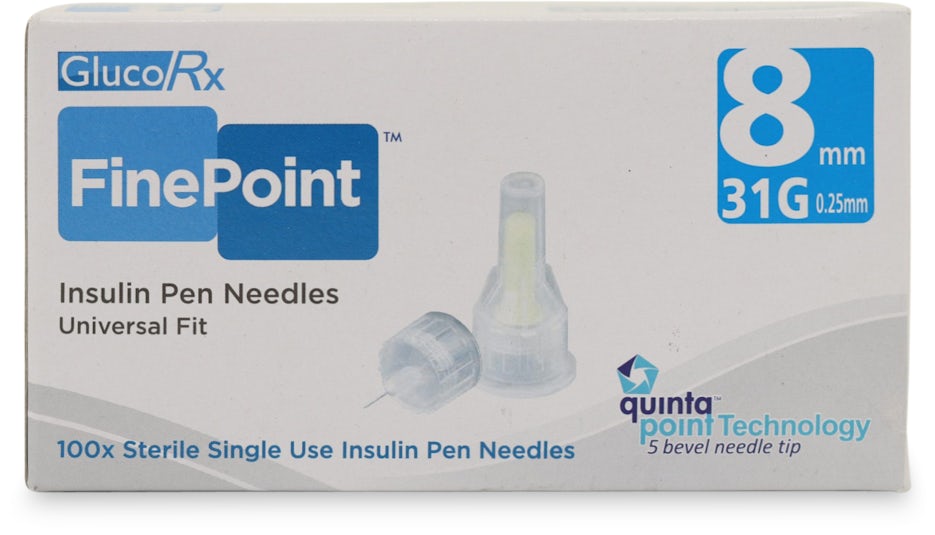
GlucoRx FinePoint Insulin Pen Needles 8mm 31G 100 Pack
What 500,000+ customers say about medino:
Description
GlucoRx FinePoint Insulin Pen Needles 8mm 31G 100 Pack are single-use needles that attach to an insulin pen for subcutaneous injection. Each box contains 100 needles, and the 8mm length is one of several FinePoint lengths, so you can match the needle to the length your healthcare professional has recommended.
Key Features
- Fits all insulin pens: The manufacturer states a universal fit on all insulin pen devices, and its website also lists GLP-1 injection pens such as Mounjaro KwikPen and Wegovy.
- 8mm length, 31G: This is one of the FinePoint sizes, which range from 4mm to 12mm. The manufacturer advises that your healthcare team helps choose the most suitable length for you.
- 5 bevel needle tip: The 8mm size has a 5 bevel tip instead of the 3 bevel tip used on the GlucoRx CarePoint range. The manufacturer says this gives a more comfortable injection.
- Single use: Each needle is for one injection only, which avoids the problems the manufacturer links to reuse, such as a dulled tip, bacterial growth and the needle breaking off.
- 100 needles per box: One box gives 100 single-use needles.
Do I need to use a skin fold with an 8mm needle?
The GlucoRx leaflet says that needles longer than 8mm in adults call for a lifted skin fold. For an 8mm needle, how you inject depends on your build and injection site, so follow the advice of your healthcare professional. If you are injecting into slim limbs or the abdomen, the leaflet notes that even short needles may need a lifted skin fold.
Can I reuse a FinePoint pen needle?
No. FinePoint needles are single use. The leaflet says reuse can cause bacterial growth on the needle, a dulled tip that makes injections more painful, and a risk of the needle breaking off or dislodging in the skin. Use a new needle for every injection.
What should I do if insulin leaks after injecting?
The leaflet suggests you may not be leaving the needle under the skin for long enough, so count slowly to 10 before withdrawing it. Some dripping after removal is not unusual, and the leaflet says it should not affect your blood glucose control.
Ingredients
Materials: The manufacturer's information available for this product does not state the needle materials.
Specification: 8mm length, 31G, 5 bevel needle tip, single use.
Usage and Instructions
- Wash your hands and make sure the injection site is clean. Load an insulin pen cartridge if necessary.
- Remove the seal from a new pen needle and attach it to your pen using the outer protective cap. Check that it is secure but not too tight, so you can fully press the dose button.
- Remove the outer cap, then the inner cap.
- If your insulin is cloudy or premixed, gently roll it at least 10 times between your palms to mix it. Some pens need gentle shaking before use.
- Prime the pen to clear air bubbles and make sure insulin flows freely through the needle.
- Dial the exact dose you need.
- Choose a site, commonly the stomach, thighs or buttocks. Avoid injecting through clothes or where blood vessels are visible. Space successive injections at least 1cm apart.
- Pinch the skin into a fold using your thumb and index finger, without including blood vessels or muscle, and inject at a 90 degree angle.
- Penetrate the skin quickly and inject slowly into the subcutaneous layer, counting up to 10 before withdrawing the needle.
- Carefully replace the outer cap if you are injecting yourself, detach the needle and discard it straight away in a sharps container, following your local medical waste disposal rules.
Always refer to the manufacturer's instructions for your insulin pen. Your healthcare team can advise on the most suitable needle length and injection technique for you.
Warnings
Please note the following precautions:
- Use a new needle for every injection. Never reuse a pen needle.
- Never share your insulin pen with anyone, because of the risk of cross contamination.
- Do not inject into sites showing lipohypertrophy (lumpy skin), oedema, inflammation or infection until the problem has resolved, and do not inject into lumps because insulin does not absorb well there.
- Insulin injected into muscle tissue is not absorbed properly. It may be painful and cause high or low blood sugars.
- Do not carry an insulin pen with the needle attached, because this lets air enter the cartridge and slows the insulin dosage time.
- Remove the caps carefully so you do not bend the needle.
- If you bleed frequently at the injection site, speak to your healthcare professional about your injection technique or any other medical problem.
Side Effects
The manufacturer's leaflet describes these possible effects at the injection site:
- Some bleeding or bruising, because the needle can puncture a tiny blood vessel. Press lightly with a cotton ball without rubbing. If a bruise appears, avoid that site until it has gone.
- Pain on injection, which the leaflet links to reusing a needle or incorrect technique.
- Insulin dripping from the needle or skin after removal, which should not affect blood glucose control.
- Lipohypertrophy (soft lumps under the skin), which can follow needle reuse or not rotating injection sites. Lipoatrophy (loss of fat under the skin) is described as rare with impure insulins.
This is not a complete list.