
Can You Get Foundayo on the NHS?
No - not yet. Foundayo (orforglipron) was authorised for use in the UK on 10 August 2026, but that's a decision about safety and effectiveness, not about NHS funding. Funding is a separate decision, made by a different organisation, and it hasn't happened yet. This page explains exactly what stage that process is at, what's actually being decided, and what a positive outcome would realistically mean for timing - without promising NHS access that doesn't exist yet.
Key takeaways
- Foundayo is MHRA-authorised but not currently available on the NHS. Those are two separate facts, decided by two separate organisations.
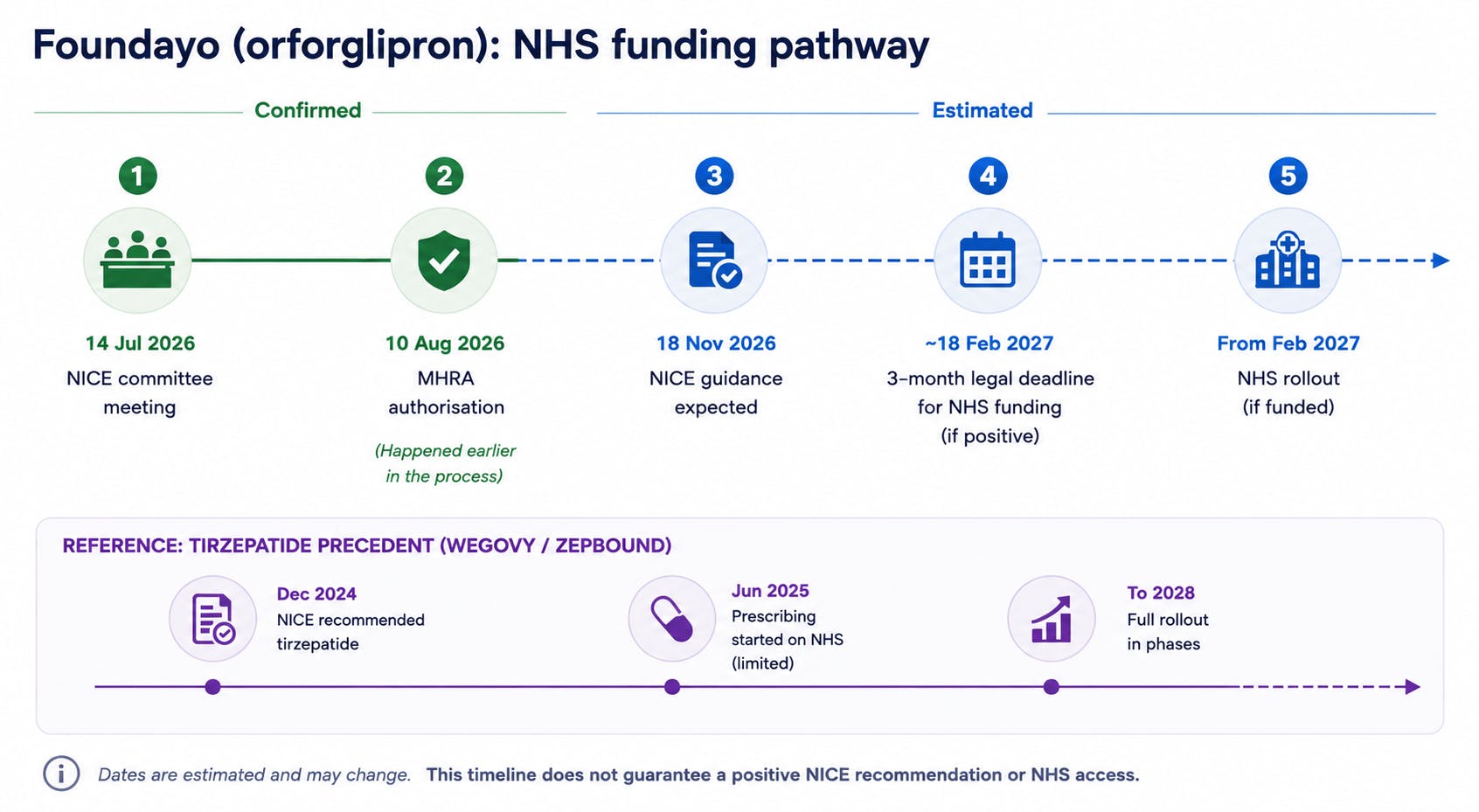
- NICE is assessing whether Foundayo is worth NHS funding for weight management, with guidance expected on 18 November 2026.
- There's no separate NICE appraisal for the type 2 diabetes use - but that doesn't mean routine NHS access for type 2 diabetes starts the moment Foundayo is authorised.
- If NICE does recommend Foundayo, the NHS has three months to start funding it by law - but recent precedent for a comparable weight-management medicine shows the real wait can be considerably longer.
- Nothing here is a promise that NICE will recommend Foundayo, or that any individual reader will be eligible if it does.
MHRA approval and NHS funding are different decisions
It helps to think of this as two different questions, asked by two different organisations.
The MHRA (Medicines and Healthcare products Regulatory Agency) asks: is this medicine safe, effective and good enough quality to be prescribed in the UK at all? It answered yes for Foundayo on 10 August 2026, making the UK the first country in Europe to authorise orforglipron.
NICE (the National Institute for Health and Care Excellence) asks a completely different question: given what it costs, is this medicine worth the NHS paying for, compared with the other options already available? That second question hasn't been answered yet.
Authorisation is what makes a medicine legally prescribable at all - privately, through a registered prescriber, once it's commercially available. It doesn't, on its own, put a medicine on the NHS. For the full picture of what Foundayo is and how it's licensed, the overview page covers authorisation, dosing and evidence in one place; this page focuses specifically on the NHS funding question.
What NICE is deciding, and when
NICE isn't re-running a safety check. Its technology appraisal process weighs two things together: clinical effectiveness (how well Foundayo works) and cost effectiveness (whether the health benefit justifies the price, against the alternatives already funded). A medicine can be genuinely effective and still not clear that second bar, if it costs significantly more than an alternative for a similar benefit.
The specific appraisal is GID-TA11650, "Orforglipron for managing overweight and obesity," running through NICE's standard technology appraisal process. A committee meeting was held on 14 July 2026, and guidance is expected on 18 November 2026. That date isn't confirmed by direct access to NICE's own systems this session - NICE's site couldn't be reached directly, so this is based on current NICE reporting rather than a document read in full - and it's worth checking again closer to the date, since appraisal timelines can shift.
Pharmacist insight: "approved" and "NICE-recommended" get used almost interchangeably in everyday conversation, but they're not interchangeable at all. If someone tells you Foundayo has been "approved for the NHS," it's worth asking exactly what they mean - MHRA authorisation and an NHS funding decision are genuinely different milestones, months apart at best. -Alessandro Grenci, Superintendent Pharmacist at medino
Type 2 diabetes: why there's no separate NICE appraisal
If you're asking about Foundayo for type 2 diabetes rather than weight management, the process is different - though not necessarily faster in practice.
NICE looked at whether orforglipron for type 2 diabetes needed its own technology appraisal, and decided against running one. The reasoning, as reported: NICE's existing type 2 diabetes guideline, NG28, already covers GLP-1 receptor agonists as a class, so a separate cost-effectiveness appraisal specifically for orforglipron wasn't judged to add enough value to justify running. This sits within a wider 2024 commitment (the voluntary scheme for branded medicines) under which NICE evaluates new medicines unless there's a clear reason not to - this appears to be exactly that exception being applied.
That's a genuinely useful fact, but it's easy to over-read. NG28 covering GLP-1 receptor agonists "as a class" isn't the same as orforglipron being named in NG28's own list of currently recommended options, which - as things stand - doesn't yet include it. Exactly how and when a newly authorised medicine like Foundayo moves from "covered in principle" to "routinely prescribed for type 2 diabetes on the NHS" isn't fully clear from anything published so far, and this page won't guess at a mechanism nobody has confirmed. If you want the fuller picture of who's likely to meet Foundayo's licensed criteria at all, weight-related or diabetes-related, Foundayo's eligibility criteria covers that in depth - this page deliberately doesn't repeat it.
If NICE recommends Foundayo: what happens next
Say NICE does recommend Foundayo on 18 November 2026. What would that actually mean for someone hoping to get it on the NHS?
By law, once NICE publishes a positive recommendation, the NHS normally has three months to make funding available. On that timeline alone, the earliest legally-required date would be around February 2027.
But that three-month rule has a built-in exception: NICE can extend it where there are genuine implementation barriers, and it has done exactly that for a comparable weight-management medicine. Tirzepatide (Mounjaro) was recommended for weight management in NICE guidance published on 23 December 2024. Given an estimated 3.4 million people potentially eligible, NHS England didn't fund it within three months - primary care prescribing didn't actually begin until 23 June 2025, roughly six months later, and the full rollout was staged across three prioritised groups over three years, from 2025 through into 2028.
That's not a prediction that Foundayo would follow the same schedule - the two medicines, and the demand behind them, aren't identical, and NICE hasn't said how it would handle Foundayo's funding if it recommends it. But it's a real, recent, directly comparable example of what "NICE says yes" can actually mean in practice for a high-demand weight-management medicine: not necessarily a fixed date a few months later, but potentially a staged rollout stretching well beyond it, starting with people judged to have the greatest clinical need. Realistically, early-to-mid 2027 at the very earliest is a reasonable estimate for anyone hoping for NHS-funded Foundayo, and a longer, phased wait is a genuine possibility, not a worst-case scare. Once something is actually available - NHS or private - how to get a Foundayo prescription covers the practical steps.
What you can do now
There's genuinely nothing to apply for yet - no waiting list, no NHS referral pathway that exists ahead of a NICE decision. But "wait and see" isn't the only option.
It's worth finding out now whether you'd be likely to meet Foundayo's licensed criteria at all, so you're not starting from scratch if NICE does recommend it later this year. It's also worth deciding, separately, whether paying privately in the meantime makes sense for you - that's not a consolation prize for NHS access being unavailable, it's a genuinely different, parallel decision with its own costs and considerations, covered in full on Foundayo's private prescription and cost page.
Pharmacist insight: a common question at the counter is some version of "should I just wait for the NHS?" There isn't a single right answer - it depends on how urgent your situation feels, what the private cost would mean for you, and how comfortable you are with genuine uncertainty about timing. Neither choice is the "sensible" one by default.
If you'd rather explore your options more broadly while this plays out, Medino's weight-loss treatments and weight management pages cover the wider range of currently available approaches.
If you want more
This page focuses specifically on the NHS funding process. A few closely related questions are covered in more depth elsewhere on Medino:
- Want the private route explained fully, including realistic UK cost expectations? See Foundayo private prescription and cost.
- Not sure whether you'd meet the licensed criteria at all, on the NHS or privately? See Foundayo eligibility criteria.
- Want the practical, step-by-step process once a route is actually available to you? See Medino's guide to getting a Foundayo prescription.
For the complete picture of what Foundayo is, how it works and what the evidence shows, see the Foundayo overview.
Frequently asked questions
If NICE says yes in November, can I get Foundayo on the NHS straight away?
Not necessarily. NICE recommending a medicine starts a legal three-month funding clock, but NICE can extend that where implementation is genuinely difficult - as it did for tirzepatide (Mounjaro) for weight management, where a positive recommendation in December 2024 was followed by a phased rollout that only reached everyone eligible over roughly three years. A recommendation is real progress, not a guarantee of immediate access.
Does having type 2 diabetes mean I can get Foundayo on the NHS sooner than for weight loss?
Not automatically. There's no separate NICE appraisal process to wait for, since existing diabetes guidance (NG28) already covers GLP-1 receptor agonists as a class - but that guideline doesn't yet list orforglipron by name among its recommended options, and how that gap closes in practice isn't confirmed yet. It's a different process, not necessarily a faster one.
Why did the MHRA approve Foundayo if the NHS can't prescribe it yet?
Because MHRA authorisation and NHS funding answer different questions. The MHRA checks whether a medicine is safe, effective and good enough quality to be prescribed in the UK at all. NICE separately checks whether it's worth the NHS paying for, compared with the alternatives. Most new medicines go through this same two-stage process - it isn't a Foundayo-specific delay.
Is there anything I can do to improve my chances of getting Foundayo on the NHS?
Not in the sense of influencing NICE's decision, which isn't something an individual patient affects. But you can be ready: check now whether you're likely to meet the licensed eligibility criteria, and keep an eye on the 18 November 2026 decision date. If NICE does recommend it, being informed about the criteria in advance means you're not starting from zero.
