
Who Is Foundayo Licensed For? Eligibility Explained
Foundayo's UK licence covers two different groups of people, for two different reasons. Which one might apply to you depends on why you're asking, not just how much you weigh. This page sets out both routes exactly as the current UK Patient Information Leaflet (PIL) states them - including the complete list of qualifying health conditions, not a shortened sample of it - plus who's explicitly excluded, and why meeting the criteria on paper isn't the end of the story.
Key takeaways
- Foundayo is licensed for two separate reasons: weight management (BMI 30+, or 27–30 with one of seven specific health conditions) and type 2 diabetes (independent of BMI or weight).
- The weight-management route needs one of a closed, seven-item list of conditions - not any general weight-related health issue.
- Foundayo isn't licensed for anyone under 18. That's a stated exclusion, not a case-by-case judgement call.
- Meeting the licensed criteria means you're within the population Foundayo can be prescribed to. It doesn't guarantee a prescriber will actually prescribe it to you.
- This page covers who Foundayo is licensed for. NHS funding and the practical prescription process are covered separately.
Two separate routes into Foundayo's licensed population
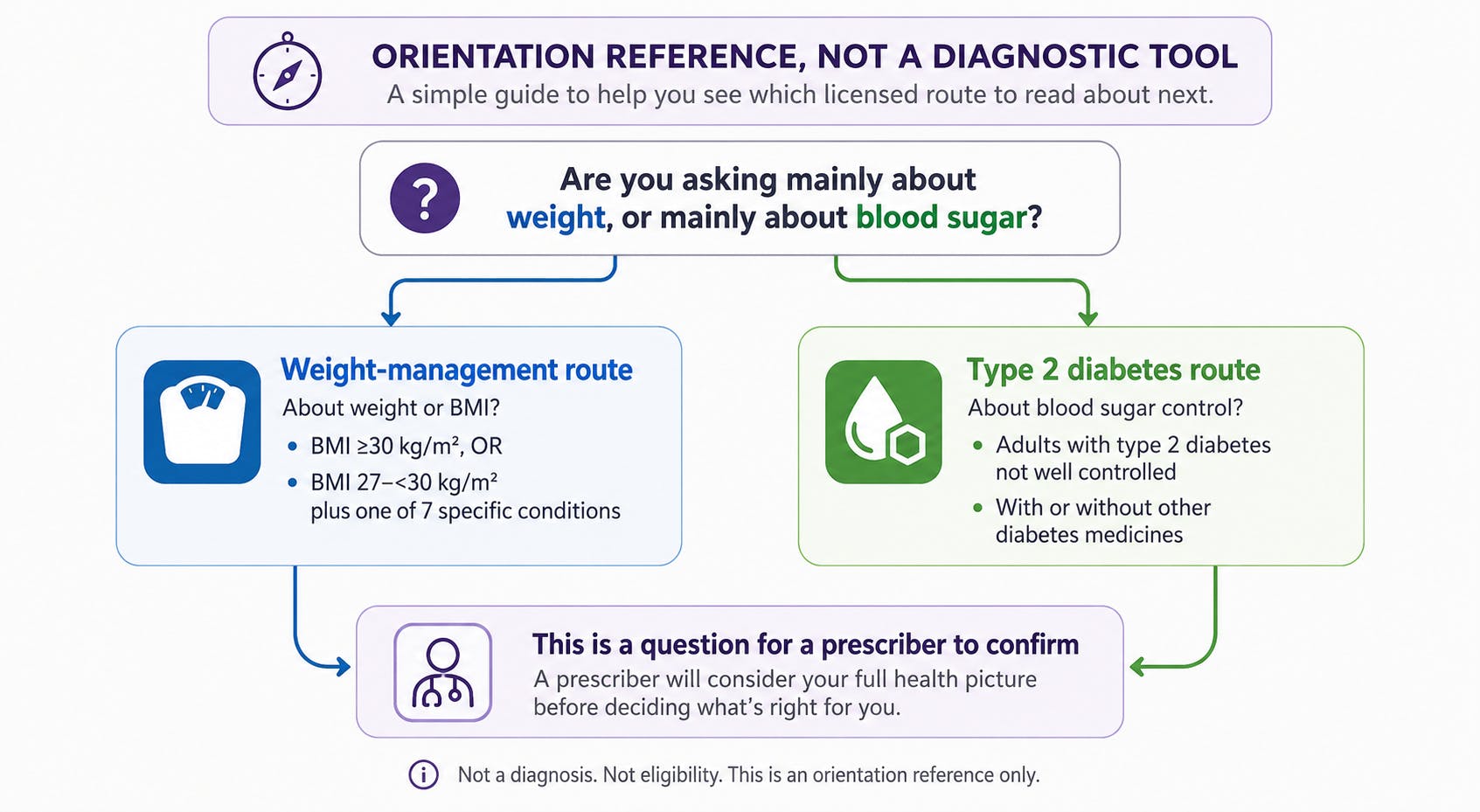
Most Foundayo coverage focuses on weight management, so it's easy to assume that's the only way to be considered for it. It isn't. The UK licence actually covers two independent populations: adults being treated for excess weight, and adults with type 2 diabetes whose blood sugar isn't well controlled. These aren't one list with diabetes as an extra tick box on it - meeting either route on its own is enough.
To make that concrete: someone with a BMI of 28 and high blood pressure could meet the weight-management criteria through the comorbidity route, without their BMI ever reaching 30. Someone else with a BMI of 24 and type 2 diabetes could be within the licensed population entirely separately, through the diabetes route, regardless of their weight. Neither needs the other.
Weight-management eligibility: BMI and the full comorbidity list
For weight management, the PIL sets out two ways in:
- a BMI of 30 kg/m² or more (classed as obesity), on its own, or
- a BMI of at least 27 kg/m² but under 30 kg/m² (classed as overweight), together with at least one of these specific health problems:
- prediabetes
- type 2 diabetes
- high blood pressure
- abnormal levels of fats in the blood
- obstructive sleep apnoea (a breathing problem during sleep)
- impaired heart function
- a history of heart attack, stroke or blood vessel problems
That's the complete list, not a set of examples. A BMI in the 27–<30 band on its own isn't enough - it needs one of these seven conditions alongside it. A BMI of 30 or more needs no additional condition at all.
The wording matters: "weight-related health problem" is easy to read as anything loosely connected to carrying extra weight - joint strain, low mood, poor sleep in a general sense. The PIL's list is narrower and more specific than that. A genuine weight-related issue that isn't one of these seven doesn't create eligibility on its own for this route, even though it may still be a real and relevant part of a wider conversation with a prescriber.
Foundayo is licensed to be used alongside a reduced-calorie diet and increased physical activity, not as a standalone treatment. That's built into the licence itself, not an afterthought added to the marketing.
Worth flagging honestly: BMI is a screening measure, not a diagnosis. It doesn't directly capture muscle mass, body-fat distribution or individual health risk, and it's the figure the licence is written around rather than a complete picture of anyone's health. A prescriber's own assessment goes beyond it - the BMI and comorbidity criteria set the boundary of the licensed population, not the full clinical judgement that follows.
Type 2 diabetes eligibility
Foundayo has a second, entirely separate licensed use: treating adults with type 2 diabetes whose blood sugar isn't properly controlled. This route doesn't reference BMI or weight at all.
It applies whether Foundayo is used on its own, or alongside other diabetes medicines when those aren't enough by themselves - medicines taken by mouth or by injection, including insulin.
It's easy to come away from most Foundayo coverage assuming type 2 diabetes is only relevant as one item on the weight-management list. It's more than that. Someone with type 2 diabetes and a BMI well under 27 can still be within Foundayo's licensed population, through this route alone - being significantly overweight isn't a requirement for it. For a closer look at the evidence behind this specific use, see Foundayo's type 2 diabetes evidence.
Who isn't eligible: the under-18 exclusion
One exclusion applies across both routes, without a case-by-case exception in the current licence: Foundayo should not be given to children and adolescents under 18. The PIL is direct about why - it hasn't been studied in this age group, so there's no evidence base to license it on for anyone younger. This isn't a soft caution a prescriber might set aside in the right circumstances; it's a stated exclusion built into the licensed population itself.
Eligibility on paper vs an individual clinical assessment
Meeting the criteria above means you're within the population Foundayo is licensed for. It doesn't mean you'll be prescribed it.
What tends to surprise people is how normal it is to be squarely within the licensed population and still not receive a prescription. An individual assessment looks well beyond the headline BMI or diabetes criteria: at your wider health, your current medicines, and whether Foundayo is genuinely the right choice for you specifically, not just whether you clear the licensing bar on paper. Separately, there's a list of situations where Foundayo needs particular caution, or isn't suitable at all for safety reasons - that's a different question from the licensed-population criteria on this page, covered in full on Foundayo's warnings and who shouldn't take it. It's worth reading before assuming that eligibility on paper settles anything.
Pharmacist insight: checking the BMI and comorbidity criteria is usually the quick part of a consultation. What tends to take longer is working out whether Foundayo actually fits someone's full picture - their other medicines, their health history, what they've already tried. Meeting the licensed criteria opens the door to that conversation. It doesn't finish it. -Alessandro Grenci, Superintendent Pharmacist at medino
What to do next if you think you might be eligible
If you think you're likely within Foundayo's licensed population, the practical next step is a conversation with a prescriber, not a self-diagnosis based on this page alone. Medino's guide to getting a Foundayo prescription covers the practical process, whichever route turns out to be relevant to you.
Two things are worth checking early, since they shape which route you'll actually take. Foundayo isn't currently available on the NHS - Foundayo's NHS availability explains exactly what stage that process is at. In the meantime, Foundayo's private prescription and cost covers what paying privately currently involves.
If you're still weighing up your options more broadly, Medino's weight management pages cover the wider range of currently available approaches. For the complete picture of what Foundayo is, how it works and what's currently known about it, see the Foundayo overview.
Frequently asked questions
My BMI is 28 and I don't have any of the listed health conditions - am I eligible?
Not currently, for the weight-management route specifically. A BMI between 27 and 30 needs one of the seven named conditions alongside it, not just the BMI itself. That could change if your health changes, and it's a separate question from whether you'd meet the criteria some other way, including the type 2 diabetes route if that applies to you. A pharmacist or GP can talk through your specific situation.
Does high cholesterol count as a weight-related health problem for Foundayo?
Yes. "Abnormal levels of fats in the blood" is one of the seven conditions the UK licence lists for the BMI 27–<30 route, often referred to informally as high cholesterol or high triglycerides. If you're in that BMI band and have this diagnosed, it may support your eligibility through that route.
Can I be considered for Foundayo for type 2 diabetes if my BMI is normal?
Yes, potentially. The type 2 diabetes route doesn't set a BMI requirement at all - it's based on whether your blood sugar is properly controlled, not on weight. It's a genuinely separate licensed use from the weight-management route, not something that only applies alongside it.
If I meet the eligibility criteria, will I definitely be prescribed Foundayo?
No. Meeting the licensed criteria means you're within the population Foundayo can be prescribed to - it isn't a guarantee that you will be. A prescriber still needs to assess your wider health, your current medicines, and whether it's genuinely the right choice for you, and there are separate safety-related reasons it might not be suitable even then.
