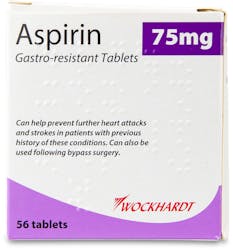
Bristol Aspirin 75mg Gastro-Resistant 56 Tablets

Bristol Aspirin 75mg Gastro-Resistant 56 Tablets
All sizes
What 500,000+ customers say about medino:
Description
Bristol Aspirin 75mg Gastro-Resistant 56 Tablets contain low-dose aspirin (acetylsalicylic acid), an antiplatelet medicine that helps prevent blood cells from sticking together and forming blood clots.
Each gastro-resistant tablet contains 75 mg of aspirin. This medicine is used to help prevent further heart attacks and strokes in people who have previously experienced these conditions. It may also be used following by-pass surgery.
The usual long-term dose is one or two tablets once daily. The 56-tablet pack is suitable for ongoing once-daily use as directed. The tablets should be swallowed whole with water and must not be cut, chewed or crushed.
This medicine is intended for adults and young people aged 16 years and over. It is not suitable for pain relief or for reducing fever. If you are taking low-dose aspirin for the first time, speak to your doctor before starting. A pharmacist can provide advice if you need further information about this medicine.
Ingredients
Main ingredients: Aspirin 75 mg per gastro-resistant tablet.
Excipients: potato starch, calcium hydrogen phosphate dihydrate (E341), microcrystalline cellulose (E460), talc (E553b), methacrylic acid-ethylacrylate copolymer containing sodium laurilsulfate and polysorbate 80, macrogol, simeticone.
Usage and Instructions
- Used to help prevent further heart attacks and strokes in people who have previously had these conditions, and following by-pass surgery.
- Adults and young people aged 16 years and over: take one or two tablets once daily.
- The usual long-term dose is 75 mg to 150 mg once daily.
- In some circumstances, doses of up to 300 mg daily may be used, but only on the advice of a doctor.
- Swallow the tablets whole with water.
- Do not cut, chew or crush the tablets.
- If you are taking low-dose aspirin for the first time, speak to your doctor before starting.
- Aspirin is not intended for children under 16 years of age unless specifically advised by a doctor.
- If you miss a dose, wait until your next dose is due and continue as normal. Do not take a double dose.
- Treatment is generally used long term and should be reviewed at regular intervals.
- Do not use this product for pain relief or to reduce fever.
- Always take the medicine exactly as directed in the leaflet or by your doctor or pharmacist.
Warnings
- Do not take this medicine if you are allergic to aspirin, other salicylates, NSAIDs or any of its ingredients.
- Do not take it if aspirin, salicylates or NSAIDs have previously caused an asthma attack, wheezing, swelling of the face, lips, tongue or throat, or another serious allergic reaction.
- Do not take it if you have or have previously had a stomach or intestinal ulcer, gastrointestinal bleeding, a bleeding stroke or a blood clotting disorder such as haemophilia or thrombocytopenia.
- Do not take it if you have gout or severe kidney or liver problems.
- Do not take it if you are taking more than 15 mg of methotrexate per week.
- Speak to a doctor or pharmacist before use if you have asthma, hay fever, nasal polyps, kidney, liver or heart problems, high blood pressure, dehydration, glucose-6-phosphate dehydrogenase deficiency, a history of stomach or intestinal problems, heavy menstrual periods or gout.
- Older people may be more susceptible to side effects and may require closer monitoring.
- Aspirin can increase the risk of bleeding. Tell your doctor, dentist or hospital staff that you take aspirin before surgery, dental procedures or blood tests.
- Seek medical advice if you develop unusual or prolonged bleeding.
- Aspirin can interact with other medicines, including anticoagulants and antiplatelet medicines, NSAIDs such as ibuprofen, corticosteroids, SSRIs, methotrexate, medicines for epilepsy, diabetes, high blood pressure, heart conditions or gout, diuretics, lithium, ciclosporin, tacrolimus, iron salts, antacids and metamizole. Check with a doctor or pharmacist before taking other medicines with aspirin.
- Alcohol may increase the risk of gastrointestinal bleeding and may make the stomach more sensitive to aspirin.
- Aspirin does not usually affect the ability to drive or operate machinery.
- During the first six months of pregnancy, aspirin should not be taken unless absolutely necessary and advised by a doctor. If needed, the lowest dose should be used for the shortest possible time.
- From 20 weeks of pregnancy, taking aspirin for more than a few days may require additional monitoring.
- During the last three months of pregnancy, doses above 100 mg per day must not be taken. Doses of 100 mg per day or less should only be used under strict obstetric monitoring.
- Breastfeeding women should not take aspirin unless advised by their doctor.
- If too many tablets are taken, contact a doctor or the nearest emergency department immediately. Overdose symptoms can include ringing in the ears, hearing problems, headache, dizziness, confusion, nausea, vomiting and abdominal pain. Severe overdose can cause rapid breathing, fever, sweating, restlessness, seizures, hallucinations, low blood sugar, coma and shock.
- Stop taking the medicine and seek medical attention immediately for severe allergic reactions, serious skin reactions, vomiting blood, black or bloody stools, coughing up blood or other serious or unusual bleeding.
Side Effects
| Frequency | Possible side effects |
|---|---|
| Serious side effects requiring immediate medical attention | Stop taking the medicine and seek medical attention if you vomit blood or material resembling coffee grounds, pass blood or black tarry stools, develop difficulty breathing, sudden wheezing, fainting, difficulty swallowing or swelling of the face, lips, tongue or throat, develop a severe blistering or peeling skin reaction, or experience serious or unusual bleeding such as blood in the urine, coughing up blood or bleeding in the brain. |
| Common | Heartburn or indigestion, increased tendency to bleed. |
| Uncommon | Runny nose, breathlessness, hives. |
| Rare | Severe bleeding in the stomach or intestines, bleeding in the brain, changes in blood cell numbers, nausea, vomiting, bronchospasm or asthma attacks, inflammation of blood vessels, bruising or purple skin spots, severe skin reactions including erythema multiforme, Stevens-Johnson syndrome and Lyell's syndrome, hypersensitivity reactions including swelling of the face, lips or body and shock, abnormal heavy or prolonged menstrual bleeding. |
| Frequency not known | Prolonged bleeding such as nosebleeds or bleeding gums, anaemia, headache, dizziness or vertigo, reduced hearing, ringing in the ears, diarrhoea, stomach or intestinal ulcers or perforation, raised uric acid levels, impaired kidney function, salt and water retention, impaired liver function. |