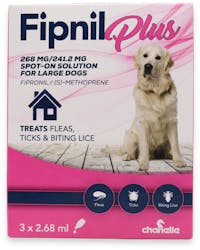
Fipnil Plus Spot-On Solution for Extra Large Dogs 3 x 4.02ml


Fipnil Plus Spot-On Solution for Extra Large Dogs 3 x 4.02ml
What 500,000+ customers say about medino:
Description
Fipnil Plus Spot-On Solution for Extra Large Dogs is a flea and tick treatment for dogs weighing over 40 kg, supplied as 3 pipettes of 4.02 ml. It treats fleas, ticks and biting lice, and stops flea eggs, larvae and pupae from developing. One pipette keeps killing new adult fleas for 8 weeks and ticks for up to 4 weeks.
Key Features
- Two active ingredients: Fipronil kills adult fleas, ticks and lice on contact, while (S)-methoprene stops flea eggs, larvae and pupae from developing.
- Treats fleas, ticks and biting lice: It is licensed for flea infestations (Ctenocephalides spp.), tick infestations (Ixodes ricinus, Dermacentor variabilis, Dermacentor reticulatus and Rhipicephalus sanguineus) and biting lice (Trichodectes canis).
- 8 weeks of flea control: New infestations with adult fleas continue to be killed for 8 weeks, and the development of flea eggs, larvae and pupae is prevented for the same period. Protection against ticks lasts up to 4 weeks.
- Pipette sized for dogs over 40 kg: Each 4.02 ml pipette contains 402 mg fipronil and 361.8 mg (S)-methoprene, giving a minimum dose of 6.7 mg/kg fipronil and 6 mg/kg (S)-methoprene for a dog weighing over 40 kg.
- Can be used in pregnancy and lactation: The product information states that it can be used in pregnant and nursing dogs.
How quickly does Fipnil Plus start working?
Fipronil kills fleas within 24 hours of exposure. Ticks and biting lice are killed within 48 hours of exposure. The parasites are killed by contact with the product in your dog's coat, rather than after taking it in through the blood.
Can I bathe my dog or let them swim after treatment?
Avoid bathing or immersing your dog in water for 2 days after application, and avoid bathing more than once a week, as this has not been studied. Emollient shampoos can be used before treatment, but if used weekly after treatment they reduce flea protection to about 5 weeks. Weekly bathing with a 2% chlorhexidine medicated shampoo did not affect flea control in a 6 week study. Do not let your dog swim in watercourses for 2 days after treatment.
Will ticks still attach to my dog after treatment?
A few ticks may still attach, so the transmission of infectious diseases cannot be completely ruled out if conditions are unfavourable.
Do I need to treat my home as well?
Fleas from pets often infest the animal's basket, bedding and regular resting areas, such as carpets and soft furnishings. In a heavy infestation, and at the start of flea control, treat these areas with a suitable insecticide and vacuum them regularly. (S)-methoprene also stops flea larvae and pupae from developing, which prevents treated dogs from contaminating their surroundings with the immature stages of fleas.
Ingredients
Active ingredients: Each 4.02 ml pipette contains 402 mg fipronil and 361.8 mg (S)-methoprene.
Other ingredients: Butylhydroxyanisole (E320) 0.80 mg, butylhydroxytoluene (E321) 0.40 mg, anhydrous ethanol, polysorbate 80 (E433), povidone and diethylene glycol monoethyl ether.
Usage and Instructions
For topical use on dogs weighing over 40 kg. Use one 4.02 ml pipette per dog, applied directly to the skin.
- Hold the pipette upright and tap the narrow part so the contents stay in the main body of the pipette.
- Snap back the tip.
- Part the coat on the back of the neck, at the base of the neck in front of the shoulder blades, until the skin is visible.
- Place the tip of the pipette on the skin and squeeze it several times to empty the contents completely onto the skin in one spot.
Leave at least 4 weeks between treatments. The coat may look clumped or greasy at the application site for a short time. Do not overdose.
Warnings
Do not use this product in the following cases, and follow the precautions below:
- Do not use on cats, as this could lead to overdosing. Do not use on rabbits, as there is a risk of adverse drug reactions or even death. Use in other non-target species is not recommended.
- Do not use on puppies less than 8 weeks old.
- Do not use on sick dogs (for example with systemic disease or fever) or dogs recovering from illness.
- Do not use if your dog is known to be hypersensitive to fipronil, (S)-methoprene or any of the other ingredients.
- Always use the pipette size that matches your dog's weight, as overdosing may increase the risk of adverse effects.
- Apply the product where your dog cannot lick it off, avoid the eyes, and stop treated dogs licking each other.
- The product can irritate the mouth, skin and eyes of people. Avoid contact, and wash your hands with soap and water if it touches your fingers. People with a known hypersensitivity to insecticides or alcohol should avoid contact.
- If the product gets into the eyes, rinse them carefully with clean water. If it is swallowed, seek medical advice immediately and show the package leaflet to the doctor.
- Do not handle treated dogs, or let children play with them, until the application site is dry. Treat dogs in the early evening rather than during the day, and do not let recently treated dogs sleep with their owners, especially children.
- Do not smoke, drink or eat while applying the product, and wash your hands afterwards.
- Keep pipettes in the original packaging until you are ready to use them, and dispose of used pipettes immediately so children cannot reach them.
- Fipronil and (S)-methoprene may harm aquatic organisms. Do not let dogs swim in watercourses for 2 days after application, and do not let the product enter watercourses.
Side Effects
Suspected side effects are very rare. The following have been reported after use:
- Temporary skin reactions at the application site, including skin discoloration, local hair loss, itching and redness.
- General itching or hair loss.
- Excessive salivation, reversible nervous signs (such as increased sensitivity to stimulation or depression), vomiting or breathing problems.
If your dog licks the product, a brief period of excessive salivation may occur, mainly due to the nature of the carrier. This list is not exhaustive.