
Foundayo Weight-Loss Trial Data Explained: ATTAIN in Depth, and Why the Numbers You'll See Vary
The honest question isn't which Foundayo weight-loss figure is correct - 11.2%, or 12.4%. It's why a single trial produced both, and why that's not a red flag. Both numbers come from the same peer-reviewed paper, are both prespecified, and are both legitimate - they just answer slightly different questions. This page explains what those questions are, covers the wider ATTAIN trial programme beyond the headline figure, and looks at what the evidence shows for specific groups of people, so you can read any Foundayo statistic and understand what it's actually telling you.
Key takeaways
- Foundayo's ATTAIN-1 trial reports two different, both-legitimate weight-loss figures for its highest dose: 11.2% and 12.4%. The difference is the analysis method, not an error.
- 11.2% is the trial's actual primary result, reported without qualification throughout the paper. 12.4% assumes everyone stuck to treatment exactly as planned - it only appears in a figure caption, not the main text.
- The ATTAIN weight-management programme has three named trials - ATTAIN-1, ATTAIN-2, and ATTAIN-MAINTAIN - each answering a different question, not one trial reported three different ways.
- Subgroup data exists for older adults and for menopause status, but it's early, not yet peer-reviewed, and in one case rests on a sample of just 10 people - worth knowing about, not worth over-reading.
- Trial averages describe what happened to a group, not a guarantee for any one person. The spread of individual results in ATTAIN-1 is wide.
The headline ATTAIN-1 and ATTAIN-2 figures, briefly
Foundayo's headline weight-loss evidence comes from ATTAIN-1, the pivotal trial in adults with obesity - or overweight with a related health condition - who didn't have type 2 diabetes. At the highest studied dose, participants lost an average of 11.2% of their starting body weight over 72 weeks, against 2.1% with placebo. The full detail - trial size, design, and how this fits into the wider picture of what Foundayo is and how it works - is covered on Medino's main Foundayo overview, so this page won't repeat it.
ATTAIN-2 ran the same design in a different population: adults with obesity and type 2 diabetes. At the highest dose, average weight loss was 9.6% against 2.5% with placebo - a genuinely smaller figure than ATTAIN-1's. That gap isn't a sign the medicine works less well in ATTAIN-2; it's a real, trial-observed difference between the two populations studied, and neither trial paper offers a confirmed explanation for exactly why.
Neither number explains why you might see a different figure again for the exact same trial. That's this page's actual subject.
Why you'll see different percentages for the same trial
Trials like ATTAIN-1 don't just report one weight-loss figure. They report at least two, on purpose, because they're trying to answer two genuinely different questions at once.
The first question: "What happened, on average, to everyone who was randomised into this trial?" This includes people who took the medicine exactly as planned, people who stopped early, and people who started something else along the way. Researchers call this the treatment-regimen estimand. It's the trial's actual primary result - the one figure the paper states without qualification, in its abstract, its results section, and its main data table. For ATTAIN-1's highest dose, that figure is 11.2%.
The second question: "What would have happened if everyone had followed the plan exactly, with nobody stopping early or switching to something else?" Researchers call this the efficacy estimand. It's a real, prespecified part of the trial's analysis plan - not an afterthought - but it describes a more idealised scenario than the treatment-regimen figure does. For ATTAIN-1's highest dose, that figure is 12.4%, and it's larger for an intuitive reason: people who stick with a weight-loss medicine for the full 72 weeks tend to lose more than people who don't, so a figure that only counts full adherence will always come out higher than one that counts everyone.
Here's the detail most coverage of this trial skips: 12.4% - the bigger, more attention-grabbing number - doesn't appear anywhere in the paper's main written results. It appears once, in the caption of a supporting figure. The number the paper actually leads with and treats as its defining result is 11.2%. Press coverage and marketing material tend to lead with the larger figure because it's the more favourable one - a common pattern across pharmaceutical communications generally, not something specific to this trial. That doesn't make 12.4% untrue. It does mean 11.2% is the more representative number for what actually happened to the average person in this trial, adherence included.
Pharmacist insight: When a patient asks me why they've seen two different numbers for the same medicine, it's almost always this exact pattern - a headline figure that assumes perfect adherence, alongside a more conservative one that doesn't. Neither is spin. The more cautious figure is usually the more useful one to plan around. -Alessandro Grenci, Superintendent Pharmacist at medino
Neither figure is wrong. Quoting one without saying which one it is - or presenting one as the "true" result and the other as an inflated marketing number - is the actual inaccuracy. This page uses the treatment-regimen figure (11.2%, 9.6% for ATTAIN-2) as the primary, headline number throughout, and names the efficacy estimand explicitly wherever it appears, for exactly this reason.
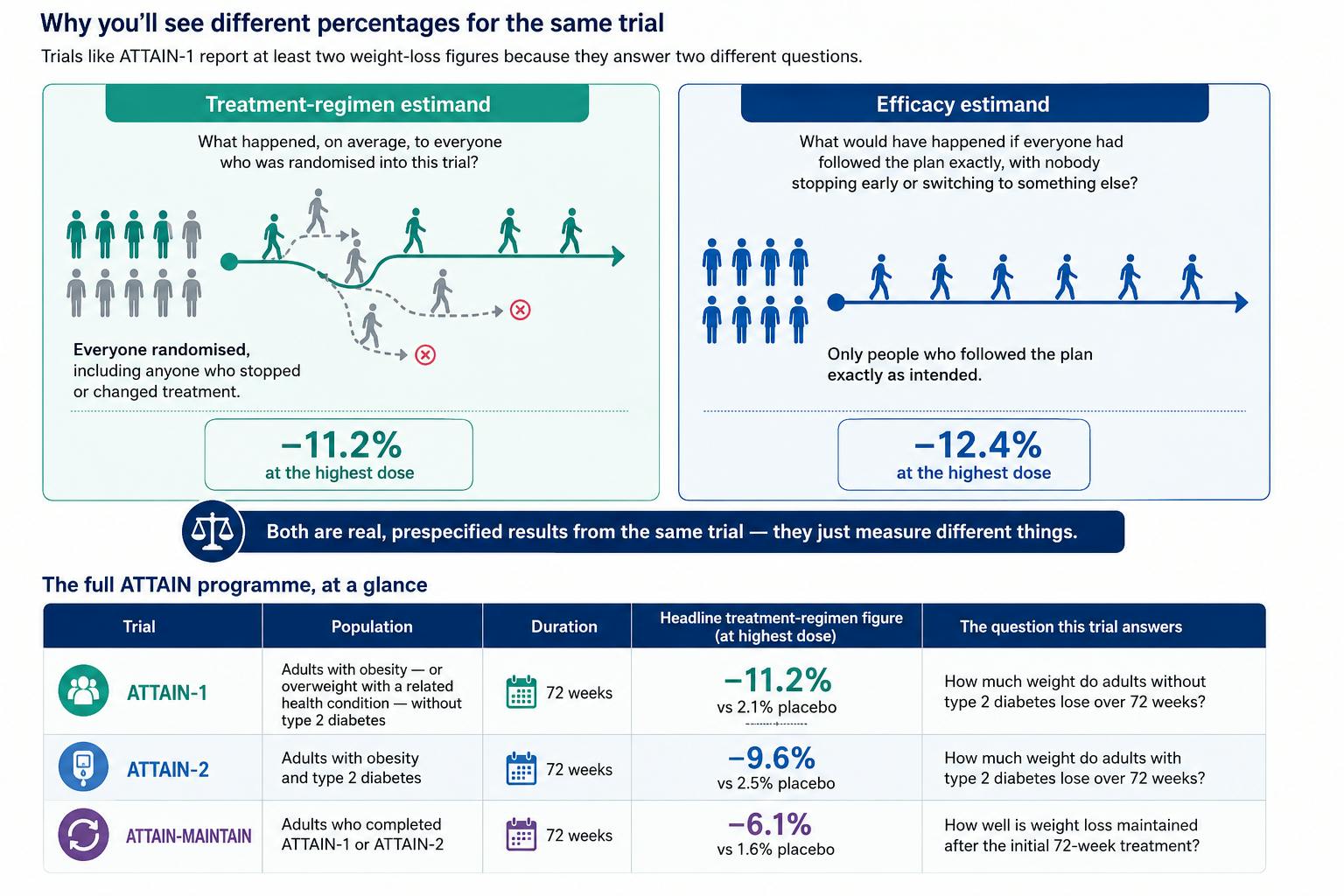
The full ATTAIN programme, beyond the headline trials
"The ATTAIN trial" isn't one thing. It's a programme of three named trials, each built to answer a different practical question.
| Trial | Population | Duration | Headline figure (treatment-regimen) | What it answers |
|---|---|---|---|---|
| ATTAIN-1 | Adults with obesity, or overweight with a related condition, without diabetes | 72 weeks | −11.2% at highest dose vs −2.1% placebo | What happens without diabetes in the picture |
| ATTAIN-2 | Adults with obesity and type 2 diabetes | 72 weeks | −9.6% at highest dose vs −2.5% placebo | What happens with diabetes in the picture |
| ATTAIN-MAINTAIN | Adults who'd already lost weight on injectable tirzepatide or semaglutide | 52 weeks | Not a fresh weight-loss figure - see below | Whether weight already lost holds after switching to Foundayo |
ATTAIN-2 also measured HbA1c, the blood test that reflects average blood sugar control, since everyone in this trial had type 2 diabetes. HbA1c fell by roughly 1.3 to 1.8 percentage points across the orforglipron dose groups, compared with around 0.1 percentage points with placebo - a meaningful improvement, though this trial's main outcome is still weight, not blood sugar. Foundayo's dedicated type 2 diabetes evidence comes from a different, separate trial programme entirely, called ACHIEVE, built specifically around HbA1c as its primary outcome rather than weight. If blood sugar control is your main interest rather than weight loss, Medino's guide to that evidence is the page built for that question, not this one.
ATTAIN-MAINTAIN is different in kind from the other two. It didn't test fresh weight loss at all - it took people who'd already lost a substantial amount of weight on an injectable GLP-1 medicine (tirzepatide or semaglutide) and tested whether switching to Foundayo held that loss in place, compared with stopping treatment altogether. That's a maintenance and switching question, not an effectiveness one, so it's covered properly elsewhere on Medino rather than here.
One more thing worth knowing if you're comparing trial figures against Foundayo's actual UK dose strengths: the trials used investigational doses labelled 6 mg, 12 mg and 36 mg, not the six commercial tablet strengths available in the UK (0.8 mg up to 17.2 mg). No source this page has been built on - including the trial papers themselves - confirms that the trial's highest dose lines up exactly with the highest commercial strength. It's a reasonable guess that they're related, but it isn't a confirmed fact, so this page avoids stating it as one. Treat any source stating that equivalence definitively with some caution.
What the evidence shows for specific subgroups
Trial averages describe what happened to the whole group. Some more specific questions - does this look different for older adults, or across different stages of menopause - have been examined too, though this evidence is newer and thinner than the headline figures above, and it's worth being upfront about exactly how thin.
Older adults. A pooled look at everyone aged 65 and over across both ATTAIN-1 and ATTAIN-2 - 613 people in total - found broadly similar weight loss to the trials' overall results, with no additional safety concerns flagged for this age group. This came from a conference poster presented in 2026, not yet a full peer-reviewed paper, so treat it as an early, reassuring signal rather than a settled conclusion.
Menopause status. A separate look, again pooling ATTAIN-1 and ATTAIN-2, examined more than 1,500 women by menopausal stage - premenopausal, perimenopausal and postmenopausal - at the highest dose. Weight loss was broadly substantial across all three groups in both trials, generally in the range of 9% to 14%, suggesting menopausal stage doesn't rule anything out on this early evidence. One figure needs a specific caveat, though: the premenopausal group within ATTAIN-2 (the diabetes trial) numbered just 10 people - too small to draw a confident conclusion from, and this page isn't going to pretend otherwise just because a percentage exists. Like the age-subgroup finding above, this was a conference poster, not yet peer-reviewed.
Both of these findings are what's called post-hoc - worked out by looking back at trial data after the fact, rather than something the trial was originally built to prove. That's a legitimate, common way research generates new questions, but it's a different, weaker kind of evidence than a trial's own prespecified primary result. Treat subgroup findings like these as "worth knowing," not "as solid as the headline figure."
What this evidence can and can't tell you about your own likely results
A trial average tells you what happened to the group as a whole. It doesn't tell you what will happen to you specifically, and no honest reading of this evidence claims otherwise.
One way to get a more realistic picture than a single average is to look at how results were actually spread across ATTAIN-1's participants. At the highest dose, just over half of people (54.6%) lost at least 10% of their starting weight. Just over a third (36.0%) lost at least 15%. Fewer than one in five (18.4%) lost at least 20%. Reading it this way - as a spread of outcomes rather than one number - gives a more honest sense of "what are my chances" than the headline average alone, because it shows plainly that plenty of people landed above the average, and plenty landed below it.
Pharmacist insight: A useful way to think about a trial average is less "this is what will happen to me" and more "this is roughly the middle of a wide range of things that happened to people broadly like the trial's participants." Your own starting point, health conditions and how consistently you take the medicine will all move you somewhere along that range. -Alessandro Grenci, Superintendent Pharmacist at medino
None of this evidence can tell you how quickly results are likely to appear for you - a different question, covered on Medino's guide to how quickly Foundayo works. It also can't tell you whether you're a suitable candidate in the first place - that depends on your own health history and a clinical assessment, not a trial statistic. Worth flagging briefly: ATTAIN-1's safety data included a small number of adjudicated pancreatitis cases, all in people taking orforglipron rather than placebo - a genuinely rare event, and one Medino's guide to Foundayo's urgent warning signs covers properly.
Frequently asked questions
If 11.2% is the "real" figure, is 12.4% just marketing?
No - both are genuine, prespecified results from the same peer-reviewed trial paper, not one accurate figure and one invented one. 12.4% describes a more idealised scenario (everyone following the plan exactly), which is why it's larger. It's real evidence, just answering a slightly different question than 11.2% does.
Does ATTAIN-2 mean Foundayo doesn't work as well for people with type 2 diabetes?
Not quite. ATTAIN-2's average weight loss (9.6% at the highest dose) was lower than ATTAIN-1's (11.2%), and neither trial paper gives a confirmed reason for that gap. It doesn't mean the medicine "doesn't work" for this group; both trials showed a clear, statistically significant difference from placebo, and ATTAIN-2 also showed a meaningful HbA1c improvement that ATTAIN-1 wasn't designed to measure.
Is there any trial evidence for people who aren't losing much weight after several months?
Not directly from ATTAIN-1 or ATTAIN-2 - those trials report outcomes at 72 weeks, not month-by-month comparisons between faster and slower responders. If you're several months in and concerned about your own progress, that's a conversation for a pharmacist or prescriber rather than something a trial average can answer, since it depends on your individual circumstances.
Why isn't ATTAIN-MAINTAIN's result a weight-loss percentage like the others?
Because it's answering a different question. Everyone in that trial had already lost weight on a different, injectable medicine before joining - the trial measured how much of that existing weight loss was maintained after switching to Foundayo, not how much new weight was lost. It's a maintenance result, not a fresh effectiveness one, which is why it's covered in full on Medino's guide to weight-loss maintenance rather than repeated here.
