How Quickly Does Foundayo Start Working?
Two people can start Foundayo (orforglipron) on the same day and have very different first few weeks. One notices their appetite change almost straight away; the other notices nothing much until their dose goes up for the first time. Neither is doing anything wrong.
Foundayo's dose increases roughly once a month, and what's realistic to expect changes at each step. That's what this page ties together: not a single "it starts working in X weeks" answer, which no one can honestly give you, but a realistic, stage-by-stage picture.
Key takeaways
- There's no single reliable "starts working in X weeks" figure - what's realistic depends on which stage of the dose-titration schedule you're on.
- Appetite and digestive changes are often noticed before anything shows on the scales. That's expected, not a sign the medicine is or isn't working.
- The 72-week figure quoted in Foundayo's trial data is the trial's own measurement point, not a personal deadline.
- Responses vary a lot between people. This page describes typical patterns, not a guarantee for you specifically.
Why there's no single "starts working on day X" answer
Search this question and some pages will give you a confident, specific-sounding answer: a claimed percentage of body weight lost by a particular week. Read numbers like that carefully.
Foundayo's UK trial evidence reports its headline result at 72 weeks. Nothing in the trial's own published paper, or in Eli Lilly's own reporting of the complete results, gives a verified figure for an earlier point like week 12. A specific number without a named, checkable source isn't more reassuring than an honest "it varies" - it's just less accurate.
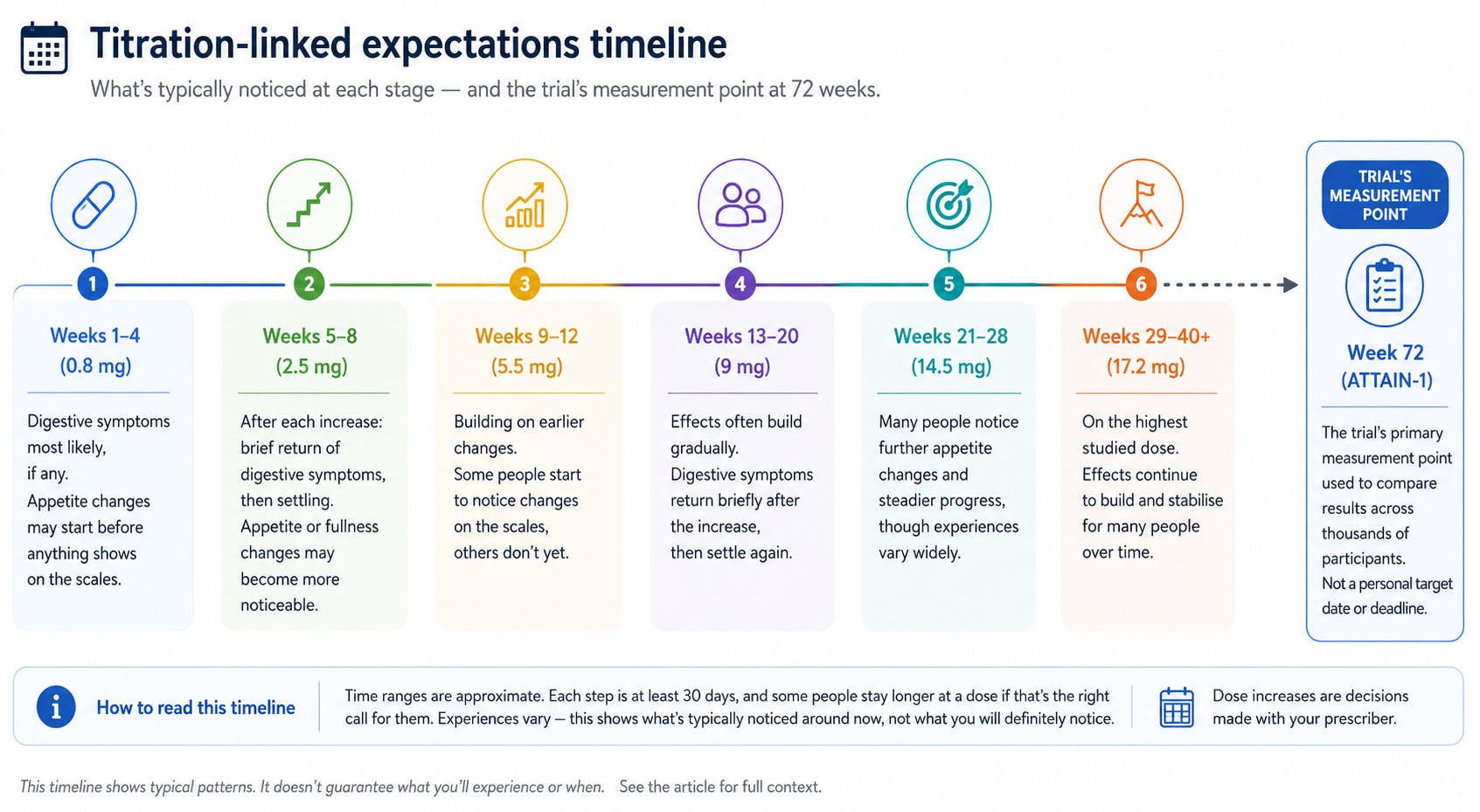
The real reason there's no single answer is more useful than that. Foundayo's dose increases gradually, roughly once a month, across up to six strengths. Someone in week 2 and someone in week 10 are, literally, taking different amounts of the same medicine. Expecting identical experiences from both isn't realistic.
What to expect at the starting dose
Foundayo starts at 0.8 mg once daily, and stays there for at least 30 days before any increase - deliberately the lowest dose in the range.
In these first few weeks, digestive symptoms are the most likely thing you'll notice, if you notice anything at all. Foundayo's UK patient information leaflet describes effects like nausea, constipation, diarrhoea and indigestion as most common when starting the medicine, easing over time for most people. That's a different signal to weight change itself, and it's worth treating as separate.
Appetite change and visible weight change don't run on the same clock. Many people notice feeling fuller sooner, or less interested in food between meals, before they notice anything on the scales. That doesn't mean the medicine is or isn't "working" yet - it means the two things are often noticed at different points, and one doesn't reliably predict the other. For the complete list of Foundayo's side effects and how common each one is, see Medino's full guide to Foundayo side effects.
What may change as the dose increases
| Stage | Daily dose |
|---|---|
| Starting dose | 0.8 mg |
| Step 2 | 2.5 mg |
| Step 3 | 5.5 mg |
| Step 4 | 9 mg |
| Step 5 | 14.5 mg |
| Highest dose | 17.2 mg |
Each step needs at least 30 days at the current dose before the next increase. Two things about that are easy to miss.
First, "at least 30 days" is a minimum, not a fixed monthly clock. If a step needs longer - because of side effects, or simply because that's the right call for you - staying there longer than a month is within the schedule, not a deviation from it.
Second, going beyond 5.5 mg isn't automatic. The UK product information describes any increase past that point as a decision made with your prescriber, based on how you're responding and tolerating the current dose, not something that happens on a fixed timetable regardless of how things are going.
Each time your dose increases, it's reasonable to expect a short return of the same early-weeks pattern: digestive symptoms are most likely right after a step up, then usually settle again before the next one. Some people notice more change in appetite with each increase; others notice things build more gradually. Both are normal.
For the exact administration details, including timing and what to do with each strength, see Medino's full guide to Foundayo dosing and titration; for how a missed dose during titration is handled, see what to do if you miss a dose of Foundayo.
What the 72-week trial timeframe actually measures
Foundayo's headline weight-loss figure - an average of 11.2% of starting body weight at the highest studied dose, versus 2.1% with placebo - comes from the ATTAIN-1 trial, measured at 72 weeks. That's not a "how long you'll wait" figure. It's the trial's own primary measurement point, chosen so researchers could compare a stable, mature result across thousands of people, not a promise about anyone's personal timeline.
A trial built to answer "how quickly" would need a different design: repeated measurements at many early timepoints, across a group large enough to make each one meaningful. That's a harder and more expensive study to run, and a different question to the one ATTAIN-1 was built to answer. For the full trial detail, including why you'll see more than one percentage quoted for the same result, what ATTAIN-2 found, and what the evidence shows for specific groups of people, see Medino's in-depth look at the ATTAIN trial data.
When to be patient vs when to check in with a prescriber
Weeks going by with little obvious change - especially early on, or right after a dose increase - doesn't on its own mean anything's wrong. It's the expected pattern for a lot of people on a gradually-titrated medicine like this.
That said, patience isn't the only acceptable answer. If you're well past the first couple of weeks, into a later dose step, and you've noticed no appetite change and no digestive signal at all, it's entirely reasonable to mention that at your next review or to a pharmacist.
That's not the same as being told you're "not responding." It's a normal, useful thing to flag so it can be looked at properly, alongside your own health history.
Pharmacist insight: the most useful thing to tell a pharmacist or prescriber isn't just "nothing's happening" - it's "nothing's changed since my last dose increase." That detail helps separate an expected quiet stretch from something worth a closer look. -Alessandro Grenci, Superintendent Pharmacist at medino
None of this is about spotting red-flag symptoms - that's a different, separate question, covered fully on Medino's guide to when to seek urgent help while taking Foundayo. This section is specifically about pace, not safety.
This page focuses on timing and expectations specifically. For the complete picture, covering what Foundayo is, how it works, and current UK availability, see Medino's full Foundayo overview.
Frequently asked questions
I've been taking Foundayo for three weeks and haven't noticed anything. Is it not working?
Not necessarily. Three weeks usually means you're still on the 0.8 mg starting dose, deliberately the lowest in the range. Many people don't notice much until a later dose. If you're concerned, it's reasonable to mention it at your next review rather than assume the medicine has failed.
Will I feel less hungry before I actually lose weight?
Often, but not for everyone. Appetite and digestive changes are commonly noticed earlier than changes on the scales, consistent with how Foundayo's most common side effects are described in the UK product information. Some people notice the reverse, or notice both together. Neither pattern predicts the other.
Does the effect restart every time my dose goes up?
Not exactly restart, but it's common to notice a short return of digestive symptoms right after an increase, before things settle again. Any appetite or weight effect from the new, higher dose is separate from that, and can take a little time to become noticeable itself.
Why do some websites give a specific week-by-week percentage and this page doesn't?
Because no source this page is built on - including Foundayo's published UK trial data - provides a verified figure for an early timepoint like week 12. Foundayo's headline result is reported at 72 weeks. A specific-sounding number without a named, checkable source isn't more accurate; it's just more specific-sounding.
