
When to Seek Urgent Medical Help While Taking Foundayo
Most symptoms while taking Foundayo (orforglipron) can wait for your next appointment. A short, specific list can't. This page sets out exactly which symptoms need a 999 call or a trip to A&E, which need a same-day call to your prescriber, and which are worth mentioning but don't need urgent action - sourced directly to the current UK Patient Information Leaflet (PIL), so the tiering reflects what's actually licensed for Foundayo, not a generic "seek medical advice" list.
Key takeaways
- Four symptom pictures mean call 999 or go to A&E: severe, unrelenting stomach-and-back pain; signs of a serious allergic reaction; signs of a bowel obstruction; and severe dehydration or kidney-problem signs.
- Sudden vision changes, severe constipation on its own, and milder dehydration signs mean contact your prescriber promptly - same day, not 999.
- If you have surgery or a procedure planned, tell your surgical or anaesthetic team you're taking Foundayo as soon as you know the date.
- Whatever the symptom, this article never tells you to stop taking Foundayo yourself - get urgent care and let a clinician make that call.
- Foundayo is under additional monitoring, so reporting a side effect through the MHRA Yellow Card Scheme genuinely helps, even if it turns out to be unrelated.
How to read this page
The three headings below match three different levels of urgency, and they're meant to be scanned, not read start to finish. If you're currently feeling unwell, jump straight to the section that matches what you're experiencing.
It's worth saying plainly: reaching for the phone for something on the 999 list isn't an overreaction, even if it turns out to be nothing serious. The side effects most people notice - nausea, indigestion, a dull ache after a dose increase - are a genuinely different picture from what's on this page: expected, and easing within a day or two, not severe and unrelenting. Someone whose stomach and back pain is severe, doesn't ease off, and doesn't feel like "just" indigestion is describing something this page treats very differently, and so should you.
Pharmacist insight: when you call 999, 111, or explain symptoms to a GP receptionist, the specific detail matters more than how urgent you sound. "Sudden" vision changes, pain "spreading to my back," or a tummy that's "swollen and I can't pass wind" gets you triaged faster than a general "I don't feel right" - use the exact words that match what's actually happening. -Alessandro Grenci, Superintendent Pharmacist at medino
Call 999 or go to A&E if...
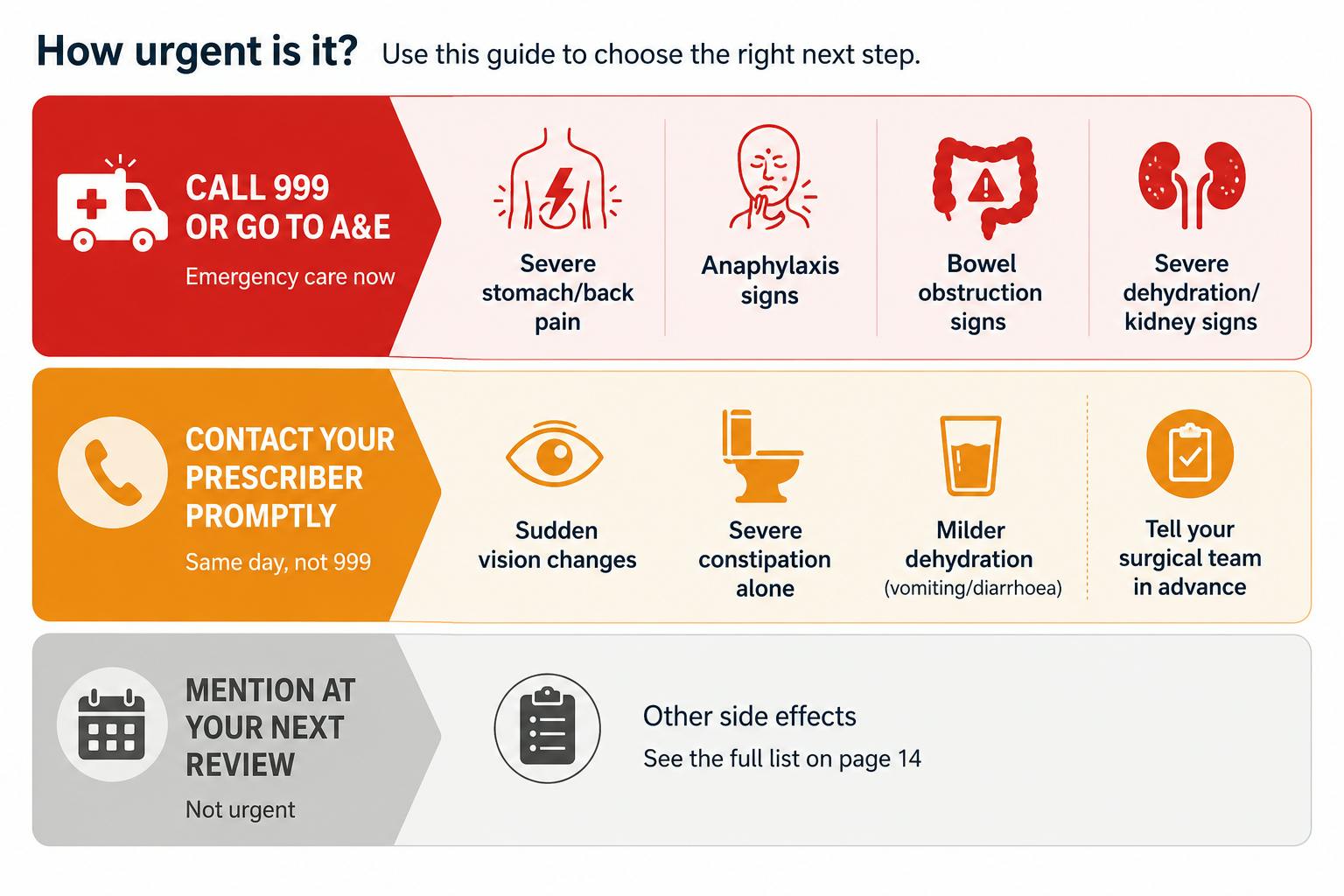
Four symptom pictures on Foundayo's UK product information warrant emergency care, not a routine appointment.
Severe, unrelenting stomach and back pain. The PIL describes this exactly: pain in the stomach and back "which does not go away." It's listed as acute pancreatitis, an uncommon (up to 1 in 100) but "serious, potentially life-threatening" effect, and the PIL's own instruction is to see a doctor immediately. NHS guidance on acute pancreatitis independently treats pain spreading to the back as one of its own criteria for calling 999 or going to A&E rather than waiting for a GP appointment - the same symptom picture, assessed the same way, from an independent source.
Signs of a serious allergic reaction (anaphylaxis). Breathing problems, swelling of the face or throat, wheezing, a fast heartbeat, pale or cold skin, or feeling dizzy or weak. The PIL's instruction is to get immediate medical help. Anaphylaxis from any cause is always a 999 emergency - if you or someone with you has an adrenaline auto-injector, use it first, then call 999 and say "anaphylaxis."
Signs of a bowel obstruction. Severe tummy pain, a swollen tummy, being sick, or being unable to pass wind or open your bowels. This combination is treated as a same-day emergency requiring hospital assessment, not something to monitor at home.
Severe dehydration or kidney-problem signs. Foundayo's PIL links kidney problems, sometimes needing dialysis, to dehydration from vomiting or diarrhoea. The point at which this becomes a 999 situation is when you can't keep fluids down at all, you're confused, unusually drowsy, breathing fast, or passing little or no urine - not simply feeling thirsty or tired.
None of this requires diagnosing yourself first. If your symptoms genuinely match one of these pictures, treat it as urgent and let a clinician confirm what's happening, rather than waiting to be sure.
Contact your prescriber promptly if...
These need a same-day response - a call to your GP, pharmacist or NHS 111 - but not an ambulance.
Sudden changes in your vision, or other unusual visual symptoms. The PIL's own instruction here is simply to tell your doctor, a notably calmer phrasing than the pancreatitis or anaphylaxis warnings - worth acting on promptly, not urgently.
Severe constipation, on its own. Listed separately from the bowel-obstruction picture above. If constipation is severe but you don't have a swollen tummy, vomiting, or an inability to pass wind at all, contact your prescriber the same day rather than waiting. If it does develop into that fuller picture, treat it as the 999-level bowel obstruction described above instead.
Milder dehydration linked to vomiting or diarrhoea, particularly if you already have kidney problems. Persistent vomiting or diarrhoea, thirst, dizziness, or dark urine that doesn't settle with fluids is worth a same-day call, even before it reaches the severe signs listed under the 999 tier.
Pharmacist insight: if you're genuinely unsure whether dehydration signs count as "prompt" or "999," a reasonable rule of thumb is whether you can keep fluids down at all. If you can sip and keep drinking, get help today. If you can't keep anything down, or you're too dizzy or confused to trust your own judgement, treat that as a 999 situation rather than a phone call to make first. -Alessandro Grenci, Superintendent Pharmacist at medino
If you have surgery or a procedure planned
This one isn't a symptom to watch for - it's something to flag in advance. Foundayo can increase the chance of food or liquid getting into your lungs during surgery or other procedures under anaesthesia, because it slows digestion. Tell your surgical or anaesthetic team that you're taking Foundayo as soon as you know a procedure is planned, rather than waiting until a pre-op appointment closer to the date.
Mention at your next review if...
Most Foundayo side effects don't belong on this page at all. Nausea, constipation, diarrhoea, indigestion and stomach pain are very common, usually mild, and tend to ease over time, especially in the weeks after starting or after a dose increase - Foundayo's full side-effect list covers these in detail, including how they're expected to pattern around dose changes. If something from that list is persistent, mild, or just worth flagging without any urgency, your next routine review is the right time, not a reason to contact anyone sooner.
Reporting side effects: the Yellow Card Scheme
Foundayo carries a black triangle (▼) symbol, meaning it's newly authorised and under additional monitoring - the MHRA is still actively building the full safety picture as more people take it. You can report any side effect, whether or not it's listed in the PIL, directly through the Yellow Card Scheme at mhra.gov.uk/yellowcard, or via the free MHRA Yellow Card app.
Pharmacist insight: reporting something that turns out to be unrelated to Foundayo isn't wasted effort - that's exactly what additional monitoring is designed to sort out. It's one of the few times flagging something you're not sure about is actively useful, not something to hesitate over. -Alessandro Grenci, Superintendent Pharmacist at medino
If you want more
This page focuses specifically on urgent and serious warning signs. A few related questions are covered elsewhere on Medino, in more depth than fits here:
- Wondering whether you should be cautious about starting Foundayo in the first place because of a past health condition? See Foundayo warnings and who should not take it.
- Pregnant, breastfeeding, or using contraception? See Foundayo, pregnancy, breastfeeding and contraception - not covered on this page at all.
- Taking other medicines and want the fuller interaction picture? See Foundayo interactions: medicines to be careful combining it with.
For the complete picture of what Foundayo is and how it's licensed, see the Foundayo overview.
Frequently asked questions
Is stomach pain after a dose increase the same as pancreatitis?
Usually not. Mild stomach discomfort in the days after starting Foundayo or increasing your dose is common and expected, and it's covered in Foundayo's full side-effect list. Pancreatitis feels different: severe, in both the stomach and back, and it doesn't ease off. If what you're feeling is mild and settling, it's very unlikely to be pancreatitis; if it's severe and not going away, treat it as described above.
Should I stop taking Foundayo if I think I'm having a serious side effect?
Don't stop it yourself. Get urgent care using the tier that matches your symptom, and let whoever treats you decide what happens with your Foundayo dose. Foundayo's own product information is explicit that you shouldn't stop taking it without talking to your doctor first, and that applies even when something feels seriously wrong - the safe next step is urgent assessment, not a decision made alone.
What if I'm not sure which tier my symptom fits?
Treat NHS 111 or a pharmacist as the tie-breaker, not a reason to wait. Exactly how quickly a symptom escalates varies between people, and the line between "prompt" and "999" isn't always obvious in the moment - that's a genuine, normal source of uncertainty, not a sign you're overthinking it.
Will reporting a side effect that turns out to be nothing cause any trouble?
No. The Yellow Card Scheme exists specifically to collect reports on a newly monitored medicine, including reports that turn out to be unrelated to Foundayo once looked into. You don't need to be certain the medicine caused something before reporting it - noting what happened and when is enough, and a clinician can help work out the rest.
