
Foundayo Warnings and Who Should Not Take It
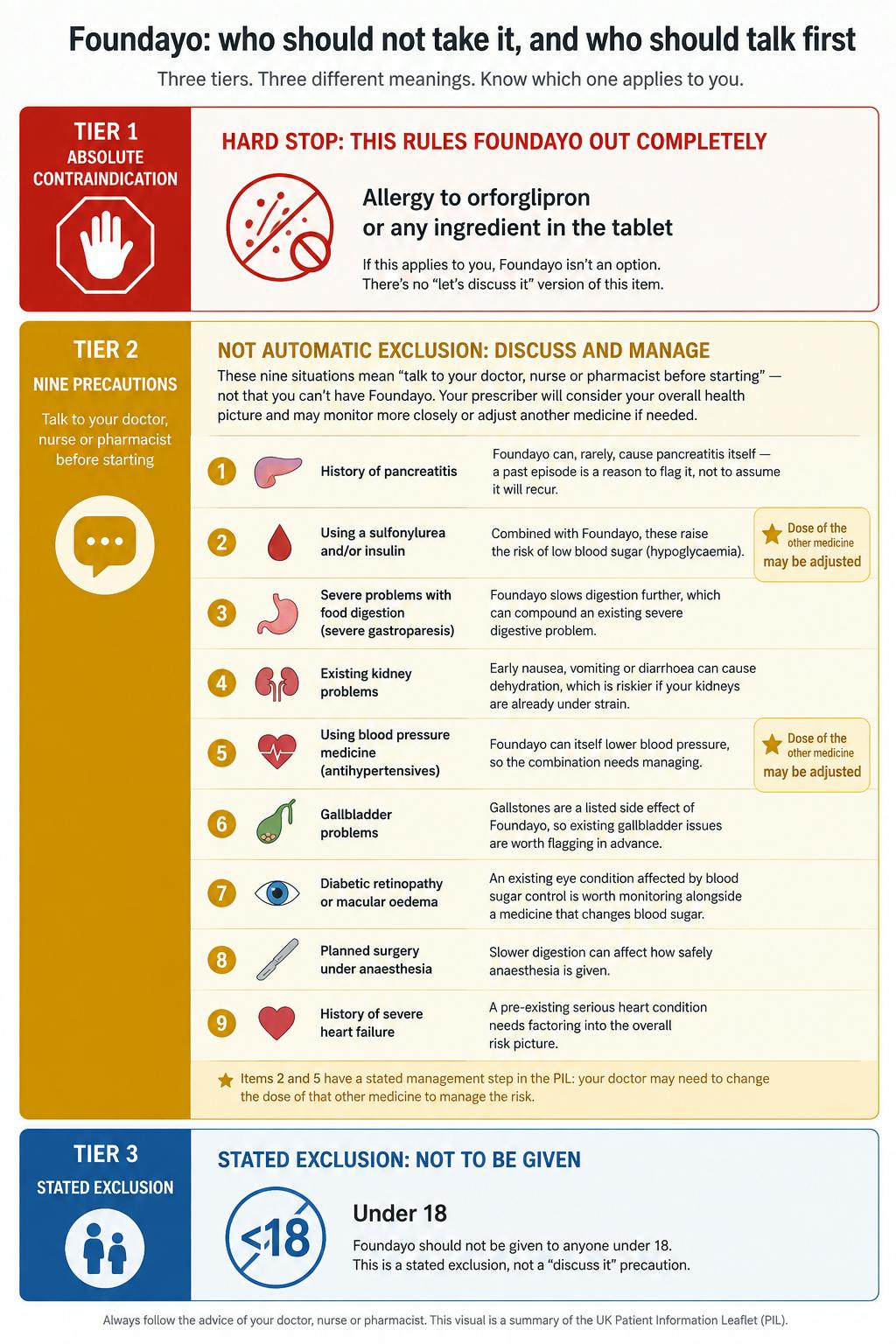
"Contraindication" and "precaution" sound like they mean roughly the same thing - a reason to be careful. For Foundayo (orforglipron), they mean two genuinely different things. Only one thing rules it out completely: an allergy to orforglipron or any ingredient in the tablet. A much longer list - nine specific health situations, set out in full below - means something different: talk to your doctor, nurse or pharmacist before starting, not "you can't have this." This article keeps those two categories separate throughout, sourced to the current UK Patient Information Leaflet (PIL), because several sources readily available online currently don't.
Key takeaways
- The only absolute contraindication for Foundayo is an allergy to orforglipron or any of its other ingredients.
- Nine other health situations mean "talk to your doctor, nurse or pharmacist before starting" - not automatic exclusion.
- Two of those nine - taking a sulfonylurea or insulin, or taking blood pressure medicine - often mean your prescriber adjusts your other medicine's dose, not that you're refused Foundayo.
- Foundayo should not be given to anyone under 18. This is a stated exclusion, not a "discuss it" precaution.
- Some searches turn up a longer contraindication list. That's usually US prescribing information, not the UK-licensed picture - see below for why that matters.
The one thing that rules Foundayo out completely
The UK Patient Information Leaflet for Foundayo states exactly one absolute contraindication: an allergy to orforglipron itself, or to any of the tablet's other listed ingredients. If that applies to you, Foundayo isn't an option, and there's no "let's discuss it and see" version of this particular item.
That's genuinely it, as far as the UK-licensed contraindication list goes. Everything else in this article - the nine-item precaution list below, and the separate under-18 rule - works differently, and it's worth understanding how before assuming any of it rules you out.
Why "talk to your doctor first" isn't the same as "you can't take this"
The PIL's own heading for the longer list is "warnings and precautions," introduced with a specific instruction: "talk to your doctor, nurse or pharmacist before taking Foundayo if..." That phrasing matters. It's asking for a conversation, not stating an exclusion.
In practice, that conversation often leads somewhere specific rather than to a flat no. For two of the nine precautions - using a sulfonylurea and/or insulin, and using blood pressure medicine - the PIL states directly that your doctor may need to change the dose of that other medicine to manage the risk, not that Foundayo itself is off the table. For others, it's closer to "your prescriber factors this in and monitors accordingly." None of the nine items automatically closes the door the way the single true contraindication does.
Pharmacist insight: most of the questions I'd expect from this list aren't really "am I excluded" - they're "does my prescriber already know about this, and will it change anything." Usually the honest answer is: it might change how closely things are monitored, or whether another medicine's dose needs adjusting, but it very often doesn't mean Foundayo is ruled out. -Alessandro Grenci, Superintendent Pharmacist at medino
The nine things to flag before you start
The table below lists every precaution exactly as the PIL sets it out, alongside why it's there. The sections after it explain the reasoning behind each one in more detail. How much weight any individual item carries for you specifically depends on your wider health picture, not a fixed rule this article can state in advance - that judgement genuinely belongs to the conversation with your prescriber, not to a general list.
| Precaution | Why it's on the list |
|---|---|
| History of pancreatitis | Foundayo can, rarely, cause pancreatitis itself - a past episode is a reason to flag it, not to assume it will recur |
| Using a sulfonylurea and/or insulin | Combined with Foundayo, these raise the risk of low blood sugar (hypoglycaemia) |
| Severe problems with food digestion (severe gastroparesis) | Foundayo slows digestion further, which can compound an existing severe digestive problem |
| Existing kidney problems | Early nausea, vomiting or diarrhoea can cause dehydration, which is riskier if your kidneys are already under strain |
| Using blood pressure medicine (antihypertensives) | Foundayo can itself lower blood pressure, so the combination needs managing |
| Gallbladder problems | Gallstones are a listed side effect of Foundayo, so existing gallbladder issues are worth flagging in advance |
| Diabetic retinopathy or macular oedema | An existing eye condition affected by blood sugar control is worth monitoring alongside a medicine that changes blood sugar |
| Planned surgery under anaesthesia | Slower digestion can affect how safely anaesthesia is given |
| History of severe heart failure | A pre-existing serious heart condition needs factoring into the overall risk picture |
Digestion and gallbladder: pancreatitis history, severe gastroparesis, gallbladder problems
Three of the nine precautions share a digestive-system logic. A past episode of pancreatitis is flagged because acute pancreatitis is itself a rare but serious listed side effect of Foundayo - a previous episode doesn't mean it will happen again, but it's exactly the kind of history a prescriber wants to know before starting a medicine that carries that specific risk. Severe gastroparesis (food staying in the stomach far longer than normal) is flagged for a related reason: Foundayo works partly by slowing digestion, and doing that on top of an already-severe digestive problem needs a prescriber's judgement, not a standard assumption.
Gallbladder problems are worth a specific note, because the connection isn't always obvious. Gallstones appear twice in Foundayo's UK product information: once here, as a reason to flag an existing gallbladder history before starting, and separately as a listed side effect that can develop during treatment. The PIL doesn't spell out the exact mechanism in patient-friendly terms, so this article won't guess at one - but the pattern is consistent with what's understood about GLP-1 medicines and rapid weight loss more broadly, and it's a real, sourced reason gallbladder history sits on this list rather than an arbitrary inclusion.
Blood sugar and blood pressure medicines: sulfonylureas, insulin, antihypertensives
Two precautions share both a mechanism and a solution. If you're using a sulfonylurea, insulin, or medicine for high blood pressure, adding Foundayo can push the combined effect further than either medicine alone - lower blood sugar than intended with the diabetes medicines, lower blood pressure than intended with the antihypertensives. In both cases, the PIL states plainly that your doctor may reduce the dose of the other medicine before or as you start Foundayo, specifically to manage this. That's a concrete, practical response, not a vague "be careful."
If you're on insulin or a sulfonylurea, it's worth knowing the warning signs of low blood sugar in advance: headache, drowsiness, weakness, dizziness, feeling hungry, confusion, irritability, a fast heartbeat and sweating. Foundayo's drug interactions covers the fuller mechanism behind this combination.
Fluid loss and kidney problems
This precaution is conditional rather than absolute. Nausea, vomiting or diarrhoea in the first weeks of taking Foundayo - or after a dose increase - can cause dehydration in anyone. For most people, that's manageable by drinking enough fluids. If you already have kidney problems, though, dehydration carries more risk, because it can put extra strain on kidneys that are already under pressure. The PIL is specific that this is "especially important if you have kidney problems," not a blanket statement that anyone with kidney issues should avoid Foundayo altogether.
Eyes, heart and surgery: diabetic retinopathy, severe heart failure, planned surgery under anaesthesia
The remaining three precautions are each tied to a specific circumstance rather than a general population concern, which is why they're grouped last, not because they matter less. Diabetic retinopathy or macular oedema - an existing eye condition linked to blood sugar control - is worth monitoring alongside any medicine that changes blood sugar levels, Foundayo included. A history of severe heart failure is flagged because it's a serious pre-existing condition that needs factoring into the overall risk-benefit picture, the same way it would for many medicines. And if you have surgery under anaesthesia planned, it's worth mentioning you're taking Foundayo, because slower digestion can affect how food or liquid behaves during the procedure.
Under-18s: not studied, not given
This one sits outside the two-tier contraindication-versus-precaution structure above, because it's neither. The PIL states it directly: Foundayo "should not be given to children and adolescents under 18 years of age because it has not been studied in this age group." That's a stated exclusion based on an absence of trial data in that age group, not a "talk to your doctor and see" precaution, and not something this article is going to soften into vaguer language than the leaflet itself uses.
Why you might see a different list online
If you've searched around before landing here, you may have already come across a longer contraindication list - one that includes a personal or family history of medullary thyroid carcinoma (a rare thyroid cancer) or Multiple Endocrine Neoplasia syndrome type 2. That's real information, but it comes from the US prescribing label, approved by the American FDA for the US market, not from the UK PIL this article is sourced to. Checked directly against the current UK Patient Information Leaflet, that contraindication and its associated warning simply aren't there for the UK-licensed product.
This isn't a minor technicality. The US and UK versions of the same medicine can be assessed and labelled somewhat differently by their respective regulators. Foundayo's own MHRA authorisation is recent enough that a lot of what's easy to find by searching still reflects the US market specifically, sometimes without saying so clearly. If you're being prescribed Foundayo in the UK, the list on this page - sourced directly to the current UK PIL - is the one that applies to you.
If you want more
This article covers reasons for caution before you start Foundayo. A few related questions are covered elsewhere on Medino, in more depth than fits here:
- Wondering what can happen once you're actually taking it? See Foundayo side effects: what they are and how common they are.
- Pregnant, breastfeeding, or using contraception? See Foundayo, pregnancy, breastfeeding and contraception - this article's precaution list doesn't cover that territory at all.
- Taking other medicines and want the fuller interaction picture beyond the sulfonylurea/insulin point above? See Foundayo interactions: medicines to be careful combining it with.
- Experiencing something right now and not sure if it needs urgent attention? See when to seek urgent medical help while taking Foundayo.
For the complete picture of what Foundayo is and how it's licensed, see the Foundayo overview.
Frequently asked questions
I have one of the precautions on this list - will I definitely be refused Foundayo?
Not necessarily. Every item in the precaution list means "your prescriber needs to know and will factor it in," which can mean closer monitoring or an adjustment to another medicine's dose, rather than an automatic refusal. Only the single allergy contraindication works as an absolute stop.
I read online that Foundayo shouldn't be taken by people with a thyroid condition - is that true?
Not according to the current UK product information. That warning comes from Foundayo's US prescribing label, which includes a contraindication for a history of a specific rare thyroid cancer and a related genetic syndrome. It isn't part of the UK-licensed contraindication or precaution list checked directly for this article. If you have any thyroid history and want it factored in regardless, it's still worth mentioning to your prescriber - but it isn't currently a stated UK exclusion.
I had gallstones years ago - does that count as a gallbladder problem I need to mention?
Yes, worth mentioning. The PIL's gallbladder precaution isn't limited to symptoms happening right now - a past history is exactly the kind of thing a prescriber would want to know about before you start, so they can judge whether anything needs extra attention.
Can I take Foundayo if I'm having surgery soon?
Tell whoever is arranging your anaesthesia that you're taking Foundayo, as part of the standard precaution. It doesn't automatically rule surgery out, but slower digestion is relevant information for anyone planning your anaesthetic care.
