
Foundayo, Pregnancy, Breastfeeding and Contraception
Foundayo (orforglipron) isn't used in pregnancy or while breastfeeding - those are the two short answers. The longer one is about contraception: Foundayo can make the contraceptive pill less effective, and the extra precaution this calls for isn't a one-off. It applies for 30 days after you start, and then again for 30 days after every dose increase, right through to your final dose.
Key takeaways
- Foundayo should not be used in pregnancy. The effects on an unborn child aren't known, and contraception is recommended while you're taking it.
- Foundayo can reduce how well the contraceptive pill works. Use a barrier method (such as a condom) as well, or switch to a non-oral method, for 30 days after starting and again for 30 days after every dose increase.
- That precaution can apply several times across a full titration schedule, not just once at the start. It's easy to forget it resets.
- Foundayo shouldn't be used while breastfeeding. It isn't known whether it passes into breast milk, and a risk to the baby can't be ruled out.
- Planning a pregnancy while taking Foundayo? Talk to your prescriber about stopping at least 3 weeks in advance, rather than timing this yourself.
Foundayo and pregnancy
If you're pregnant, think you may be pregnant, or are planning to have a baby, the UK Patient Information Leaflet (PIL) for Foundayo is direct: ask your doctor for advice before using this medicine. Foundayo should not be used during pregnancy, because the effects of the medicine on an unborn child are not known.
That's a genuinely honest position, not a soft way of saying it's harmful. Nothing in Foundayo's current UK licensing states that it causes harm in pregnancy. The PIL says plainly that this hasn't been established either way, because pregnant women aren't included in the trials that support a medicine's licence. Not being able to rule something out is treated the same way as a known risk - the standard, cautious approach for any medicine without pregnancy safety data, not a signal specific to Foundayo.
Because of that unknown, it's recommended you use contraception while taking Foundayo. If you think you might already be pregnant, don't try to work that out from this page alone - contact your doctor for advice, rather than stopping or continuing Foundayo based on your own judgement.
The oral contraceptive interaction: why it resets with every dose increase
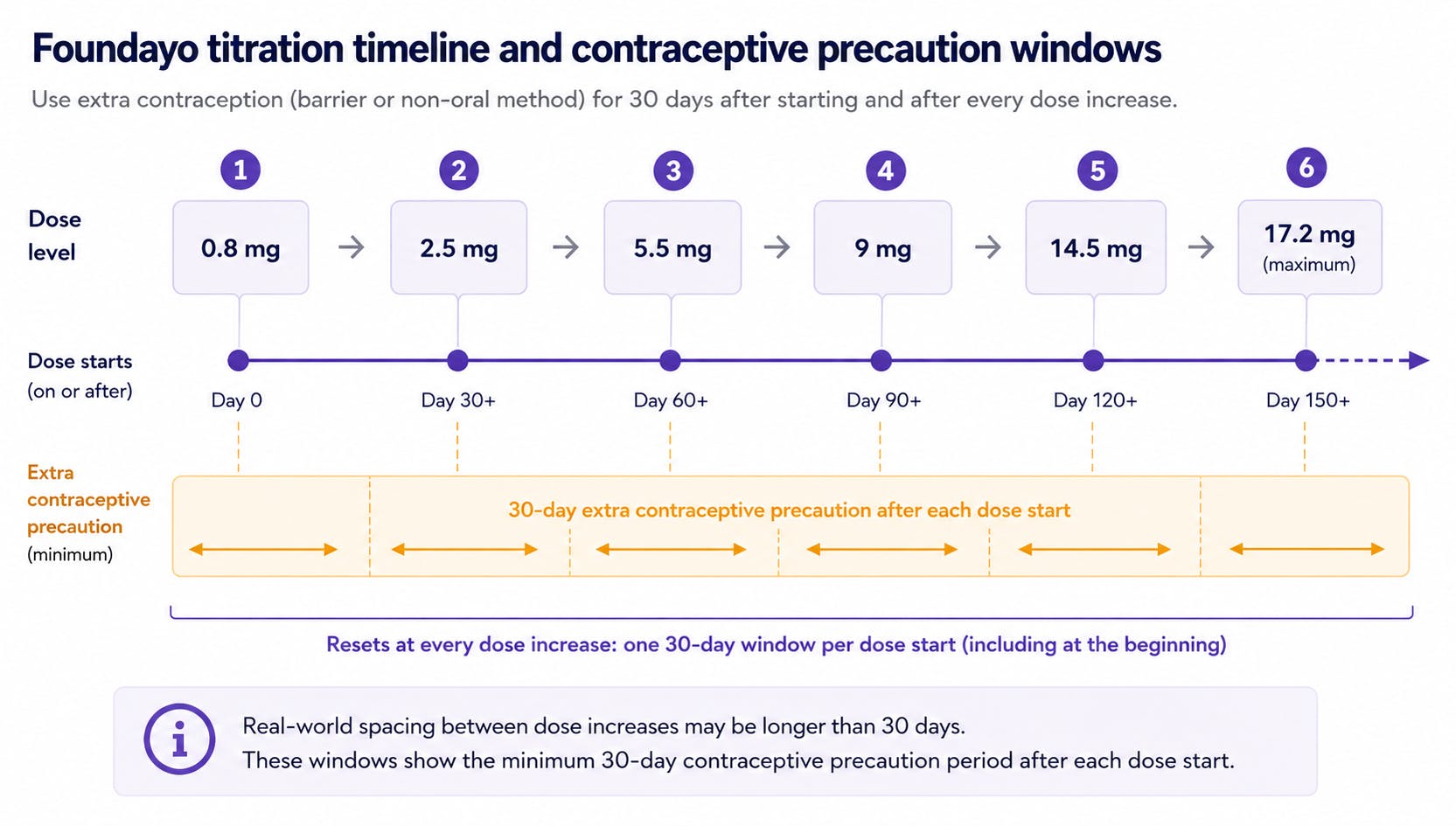
Foundayo can make oral hormonal contraceptives less effective. The UK PIL is specific about what to do: if you're using the contraceptive pill, use a barrier method as well - a condom, for example - or switch to a non-oral method of contraception, for 30 days after you start Foundayo and for 30 days after every increase in your dose.
That last part is the detail most people miss. It isn't a rule that applies once, at the start of treatment, and then stops mattering. Foundayo's dose rises in six steps - 0.8 mg, 2.5 mg, 5.5 mg, 9 mg, 14.5 mg, up to a maximum of 17.2 mg - and your prescriber won't move you to the next step until you've been on the current one for at least 30 days. Each time that happens, the 30-day contraceptive precaution starts again. Across a full titration schedule, that's potentially six separate windows: one when you start, and one after each of up to five dose increases, spread over several months.
For example, someone who's just started Foundayo and remembered to use condoms alongside their usual pill for the first month is doing exactly the right thing. But if their dose goes up again in month four, the same 30-day precaution applies again from that point, even though the actual start of treatment feels like a while ago by then.
Pharmacist insight: the easiest way not to lose track of this is to note the date of every dose increase somewhere you'll actually see it - a phone reminder set for 30 days later works well, or a mark on a calendar or the medicine box itself. Relying on memory alone, across a schedule that can run several months, is where this gets missed. -Alessandro Grenci, Superintendent Pharmacist at medino
If you've already had a dose increase and didn't realise the precaution applied again, that's not an emergency, but it's worth a call to your pharmacist or GP for advice rather than waiting to see what happens.
The PIL doesn't split its guidance by specific pill type - it's written for a woman using oral contraceptives generally, which covers the combined pill and the progestogen-only pill alike. If you want to check exactly how this applies to your own method, ask a pharmacist directly rather than assuming.
This is one specific example of a wider pattern: Foundayo can interact with a number of other medicines, not just contraception. See Foundayo interactions: medicines to be careful combining it with for the fuller list.
Foundayo and breastfeeding
It isn't known whether orforglipron, the active ingredient in Foundayo, passes into breast milk, and a risk to a newborn or infant can't be ruled out. Because of that, the UK PIL is clear that Foundayo should not be used while breastfeeding.
This sits alongside the pregnancy advice above for the same underlying reason. It isn't that Foundayo is known to cause a specific problem for a breastfeeding baby - it's that the safety data doesn't yet exist to say either way. If you're breastfeeding and want to discuss your options, that's a conversation for your GP or health visitor, not something to weigh up alone from a general leaflet.
Planning a pregnancy while taking Foundayo
If you're taking Foundayo and want to plan a pregnancy, the PIL sets out a specific step: talk to your doctor about changing your treatment, because you should stop using Foundayo at least 3 weeks before trying to conceive. This is a change made under medical guidance, not something to time yourself. Your doctor can talk through what it means for your wider treatment plan, especially if you're taking Foundayo for type 2 diabetes as well as weight management.
If you've read a different figure elsewhere, it may not be about Foundayo specifically. Some general guidance for GLP-1 medicines as a class recommends stopping two months or more before trying to conceive. Other GLP-1 medicines, such as semaglutide or liraglutide, are injected peptides that generally stay in the body longer than a small-molecule tablet like Foundayo - a plausible part of why that wider guidance differs, though Foundayo's own UK product information doesn't itself spell out the reason, only the figure. What it does state clearly is 3 weeks, not two months, and that's the figure that applies to Foundayo specifically. It's worth checking which medicine any advice you've seen elsewhere is actually about, especially if you've taken more than one GLP-1 medicine before.
Pharmacist insight: it's easy to assume every GLP-1 medicine carries the same pregnancy-planning timeline, especially if you or someone you know has taken a different one before. They don't. Always work from the timeframe stated for the specific medicine you're actually taking. -Alessandro Grenci, Superintendent Pharmacist at medino
If you want more
This article covers Foundayo's pregnancy, breastfeeding and contraceptive-interaction guidance specifically. A few related questions are covered elsewhere on Medino, in more depth than fits here:
- Wondering about other precautions before starting Foundayo, beyond pregnancy and contraception? See Foundayo warnings and who should not take it.
- Taking other medicines alongside Foundayo and want the full interaction picture? See Foundayo interactions: medicines to be careful combining it with.
- Not sure if you're eligible for Foundayo in the first place? See who Foundayo is licensed for.
- Experiencing something right now and not sure if it needs urgent attention? See when to seek urgent medical help while taking Foundayo.
For the complete picture of what Foundayo is and how it's licensed, see the Foundayo overview.
Frequently asked questions
Does the contraceptive interaction apply to the mini pill as well as the combined pill?
The UK PIL doesn't split its guidance by specific pill type - it applies to a woman using oral contraceptives generally, which covers both the combined pill and the progestogen-only pill (mini pill). The recommended action is the same either way: use a barrier method as well, or switch to a non-oral method, for 30 days after starting Foundayo and after each dose increase. For confirmation specific to your own contraceptive brand, ask a pharmacist.
I've already had a dose increase and didn't use extra contraception. What should I do?
This isn't an emergency, but it's worth acting on rather than leaving. Contact your pharmacist or GP for advice, and consider using a barrier method going forward until you've spoken to them. They can talk through what the missed window means for you specifically, including whether emergency contraception is worth discussing depending on your situation.
Can I use a non-oral contraceptive instead of doubling up with a barrier method?
Yes. The PIL gives you a choice: use a barrier method, such as a condom, alongside your existing oral contraceptive, or switch to a non-oral method, such as an implant, injection, coil or patch, for the 30-day precaution period. Which suits you better is worth discussing with a pharmacist or GP, since it depends on your wider contraceptive needs, not just this one medicine.
Is it definitely true that Foundayo harms an unborn baby?
No, and it's worth being precise about this. The UK PIL states that the effects of Foundayo on an unborn child are not known, not that harm has been confirmed. Because that safety data doesn't yet exist, Foundayo isn't used in pregnancy, and contraception is recommended, following the standard cautious approach used for any medicine without pregnancy safety evidence.
