
Foundayo Side Effects: What They Are and How Common They Are
Most people who take Foundayo (orforglipron) get mild stomach-related side effects, especially in the first few weeks or after a dose increase. A much smaller number get something more serious, including a rare but potentially life-threatening inflamed pancreas. This article lists Foundayo's side effects exactly as they're categorised in the current UK product information, from very common through to rare, so "common" and "serious" mean something precise rather than vague.
Key takeaways
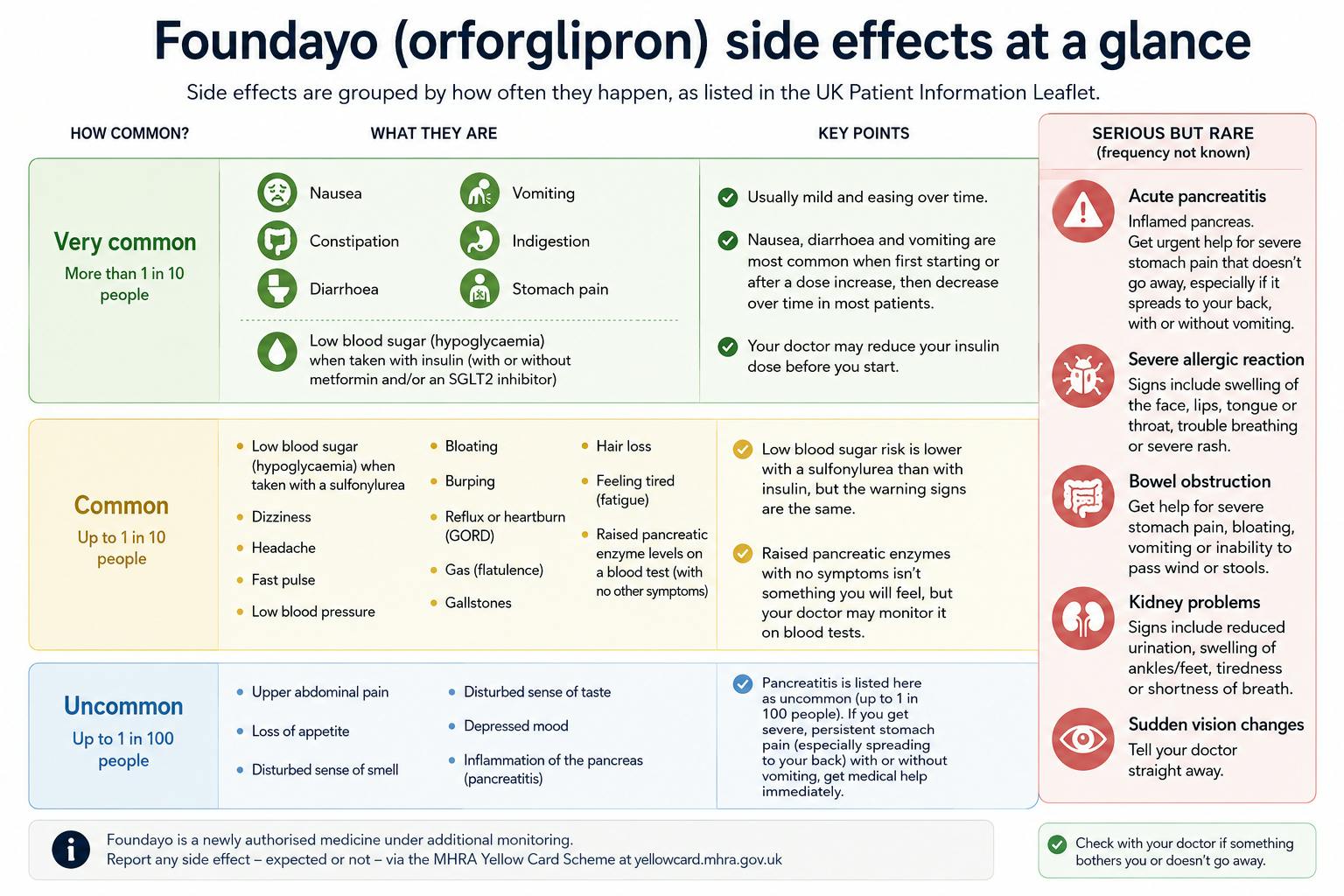
- Very common side effects (affecting more than 1 in 10 people) are nausea, constipation, diarrhoea, vomiting, indigestion and stomach pain - usually mild and easing over time.
- Low blood sugar is also very common if you're taking Foundayo alongside insulin, but a less frequent, separate risk if you're taking it with a sulfonylurea instead.
- The most serious listed effect is acute pancreatitis, which is uncommon but needs immediate medical attention if it happens.
- A handful of other serious effects (severe allergic reaction, bowel obstruction, kidney problems, sudden vision changes) are rare enough that their exact frequency isn't known, but you should still know the warning signs.
- Foundayo is a newly authorised medicine under additional monitoring, so reporting any side effect - expected or not - genuinely helps build the safety picture.
How this article is organised
The UK Patient Information Leaflet (PIL) for Foundayo groups side effects by how often they happen: very common, common, uncommon, and a small number where the exact frequency isn't yet known. That's the structure used below. Knowing which tier something falls into is genuinely useful - it's the difference between "expect this" and "this would be unusual, mention it."
Pharmacist insight: most questions I'd expect people to have aren't really "what are the side effects" - they already suspect the answer is stomach-related. The more useful question is "is what I'm feeling normal, or should I actually do something about it?" That's exactly what the tiers below are for. -Alessandro Grenci, Superintendent Pharmacist at medino
Very common side effects (more than 1 in 10 people)
The most frequently reported effects are gastrointestinal: feeling sick (nausea), constipation, diarrhoea, being sick (vomiting), indigestion (dyspepsia) and stomach (abdominal) pain. The PIL is specific that these are "usually not severe," and that nausea, diarrhoea and vomiting in particular "are most common when first starting orforglipron but decrease over time in most patients" - in other words, the first few weeks and the period just after each dose increase are when you're most likely to notice something, and it's expected to settle rather than build.
There's a second effect in this same very-common tier that's easy to miss: low blood sugar (hypoglycaemia), specifically when Foundayo is taken alongside insulin, with or without metformin and/or an SGLT2 inhibitor. This is worth stating plainly, because it's genuinely the most frequent side effect combination in the whole leaflet after the core GI symptoms - not a minor footnote. If you're on insulin, your doctor may reduce your insulin dose before you start Foundayo specifically to manage this. Warning signs of low blood sugar include headache, drowsiness, weakness, dizziness, feeling hungry, confusion, irritability, a fast heartbeat and sweating.
In practical terms, the GI symptoms tend to follow the same pattern each time your dose goes up: a few days of feeling more sensitive to nausea or changes in bowel habit, then a return closer to how you felt before the increase, before the next step some weeks later. That doesn't mean every dose increase will cause a noticeable flare, and it doesn't mean the symptoms will get worse each time - the PIL's own finding is that these effects decrease over time in most patients, not that they build cumulatively. If a particular increase causes symptoms that don't settle within a week or two, or that stop you eating or drinking normally, that's worth raising with your prescriber rather than waiting it out indefinitely.
Pharmacist insight: the timing pattern matters more than people expect. If nausea shows up in the first week after a dose change and eases off, that's exactly what the licensing data describes. If it's still there a month later, or it's new at a point where your dose hasn't changed, it's worth mentioning at your next check-in rather than assuming it's just "part of the deal." -Alessandro Grenci, Superintendent Pharmacist at medino
Common side effects (up to 1 in 10 people)
A step down in frequency from the very-common tier, and worth distinguishing from it precisely:
- Low blood sugar (hypoglycaemia), when Foundayo is used with a sulfonylurea (alone, or combined with up to two other diabetes medicines) - this is a genuinely lower-frequency risk than the insulin combination above, even though both involve the same warning signs.
- Dizziness
- Headache
- Fast pulse
- Low blood pressure
- Bloating
- Burping
- Reflux or heartburn (gastro-oesophageal reflux disease, GORD)
- Gas (flatulence)
- Gallstones
- Hair loss
- Feeling tired (fatigue)
- Raised pancreatic enzyme levels on a blood test (with no other symptoms)
Two of these are worth a brief note, since they can sound alarming out of context. Hair loss and gallstones aren't explained in Foundayo's UK product information, and this article won't guess at a mechanism that isn't sourced - but they're both listed at the same "common" frequency as several effects more obviously linked to digestion, which is a reminder that "common side effect" covers a genuinely varied list, not just stomach symptoms. Either is still worth mentioning to a pharmacist if it happens, particularly gallstones, which the leaflet lists alongside a specific pattern of symptoms (upper stomach pain, yellowing of the skin or eyes, pale stools, fever) that would justify contacting a doctor.
Uncommon side effects (up to 1 in 100 people)
- Low blood sugar (hypoglycaemia), when Foundayo is used without insulin or a sulfonylurea - the least frequent of the three hypoglycaemia scenarios.
- An unusual sense of taste
- An unpleasant or abnormal feeling when touched
Serious side effects
Uncommon, but the one to know before you start: acute pancreatitis (inflammation of the pancreas). The PIL's own description is specific and worth repeating exactly: severe pain in the stomach and back which does not go away. This is described as a serious, potentially life-threatening condition, and you should see a doctor immediately if it happens. This effect is specifically listed for orforglipron in its own UK product information - it isn't something inferred from other weight-loss or diabetes medicines.
A small number of other serious effects are listed as "frequency not known," meaning they've been reported but not often enough to estimate how common they actually are:
- Sudden changes in vision, or other unusual visual symptoms
- Bowel obstruction - severe tummy pain, a swollen tummy, vomiting, or being unable to pass wind or open your bowels
- Severe constipation
- A serious allergic reaction (anaphylaxis) - breathing problems, swelling of the face or throat, wheezing, a fast heartbeat, pale or cold skin, feeling dizzy or weak
- An increased chance of food or liquid getting into the lungs during surgery or other procedures
- Kidney problems, sometimes needing dialysis, often linked to dehydration from vomiting or diarrhoea
If any of these sound like what you're experiencing, when to seek urgent medical help while taking Foundayo sets out exactly what to do and how quickly.
Side effects and trial evidence: what ATTAIN-1 adds
The PIL's frequency tiers above come from the full clinical development programme reviewed by the MHRA. The pivotal ATTAIN-1 trial, published in the New England Journal of Medicine, adds some useful real-world-scale context on top of that, though its own figures describe that one specific trial rather than the licensed frequency categories themselves.
In ATTAIN-1, side effects led to stopping treatment in 5.3% to 10.3% of people taking orforglipron, compared with 2.7% on placebo - and gastrointestinal effects were the main reason, mostly occurring during dose escalation. Put another way: the large majority of people in the trial who started orforglipron did not stop because of side effects. Five cases of pancreatitis were confirmed among 2,178 people who took orforglipron across the trial's dose groups (none in the placebo group); in four of those five, no complications were reported. The trial also found no cases of a specific thyroid cancer sometimes discussed with this medicine class, and no liver-safety concerns despite this being specifically checked for.
Reporting side effects
Foundayo carries a black triangle (▼) symbol, meaning it's a newly authorised medicine under additional monitoring - the MHRA is actively gathering more safety information as more people take it. This makes reporting genuinely useful, not just a formality: tell your doctor, nurse or pharmacist about any side effect, including ones not listed here, or report it yourself directly through the MHRA's Yellow Card Scheme (mhra.gov.uk/yellowcard, or the MHRA Yellow Card app).
If you want more
This article covers what side effects exist and how often they happen. A few related questions are covered elsewhere on Medino, in more depth than fits here:
- Wondering if you should be cautious about starting Foundayo in the first place because of a past health condition? See Foundayo warnings and who should not take it.
- Taking other medicines and want the fuller interaction picture beyond the hypoglycaemia point above? See Foundayo interactions: medicines to be careful combining it with.
- Pregnant, breastfeeding, or using contraception? See Foundayo, pregnancy, breastfeeding and contraception - Foundayo has a specific effect on hormonal contraception that isn't covered here.
- Not sure if what you're feeling needs urgent attention right now? See when to seek urgent medical help while taking Foundayo.
- Want to know what people are actually reporting day to day, beyond the clinical picture? Early Foundayo side effects: what people are reporting online covers real, forum-sourced accounts - genuinely useful for a sense of lived experience, but personal reports, not clinical evidence of how common or serious a side effect actually is. Use it alongside this article, not instead of it.
For the complete picture of what Foundayo is and how it's licensed, see the Foundayo overview.
Frequently asked questions
Do side effects mean Foundayo isn't working, or is working?
Neither, reliably. Very common early side effects like nausea are related to how the medicine slows digestion and affects appetite signals, not to how much weight you'll eventually lose - the two don't move together in any reliable way. Some people notice side effects a lot early on and go on to see strong results; others notice just as much and see more modest results. Some people notice very little and still see substantial results; others notice very little and see modest results too. Side effects aren't a useful way to judge whether treatment is working.
What if I'm sick shortly after taking a dose?
Don't take another dose to replace it - the PIL's instruction for missed or incomplete doses is not to double up. If vomiting is frequent or you're worried about dehydration, especially if you have kidney problems, contact your doctor or pharmacist rather than waiting it out alone.
Can I take something for the nausea or indigestion?
Possibly, but check with a pharmacist first rather than assuming - what's suitable depends on what else you're taking and why the symptom is happening. This is exactly the kind of question worth a quick pharmacist conversation rather than guessing.
Will side effects get worse every time my dose increases?
Not necessarily worse, but a fresh bout of GI symptoms around each dose increase is common, since the PIL notes symptoms are most common when starting or increasing the dose. They're not expected to compound cumulatively with each step.
